
Can You Stay at Rila Monastery? Rooms & Rules
Yes, Rila Monastery rents rooms to overnight guests, by phone only, no online booking, no published rate. How to book, the house rules and the catches.
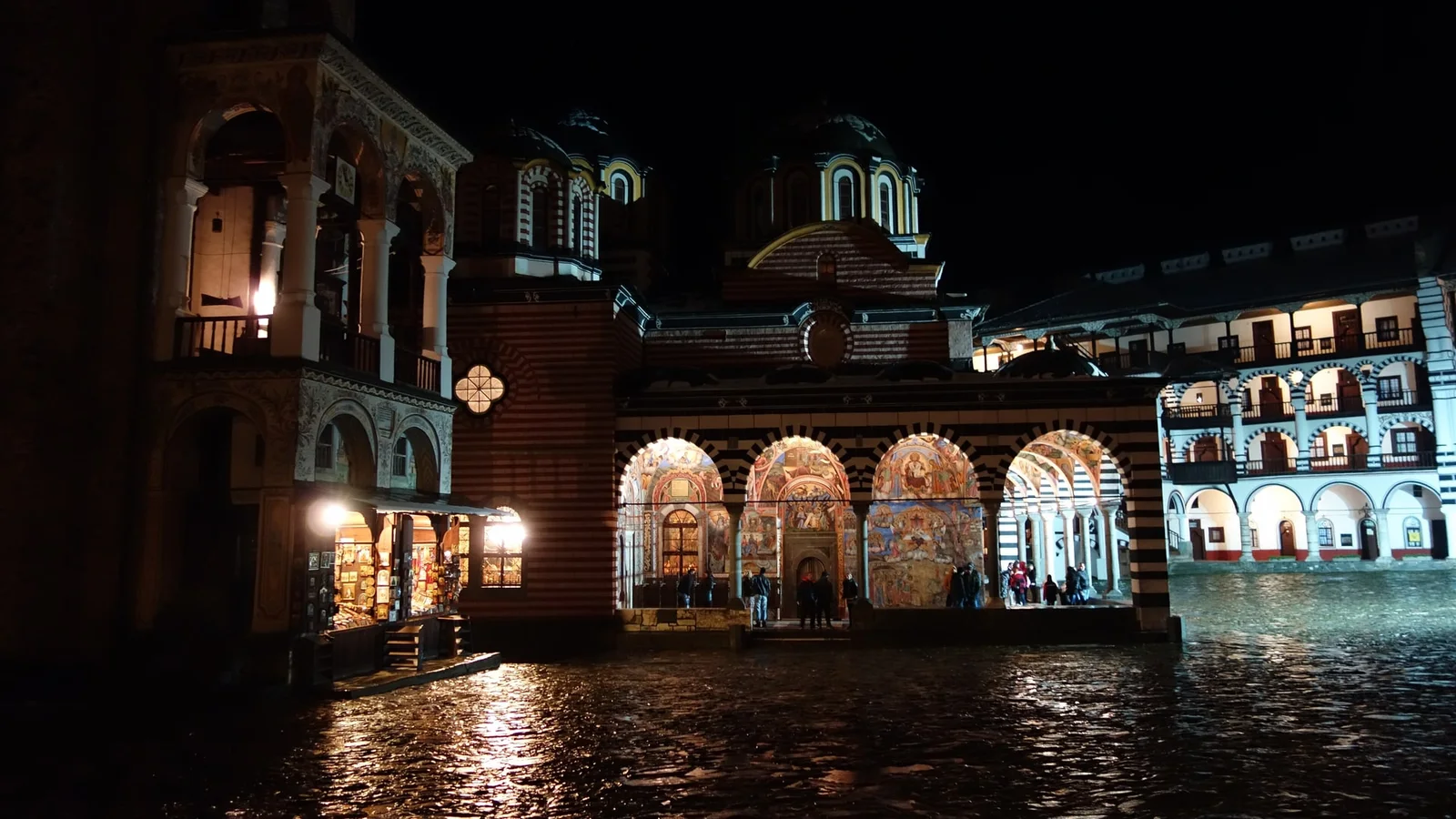
Yes: Rila Monastery rents rooms to overnight guests, and you book it through a phone line that’s staffed for a few hours on weekdays. There’s no booking page and no rate card on the monastery’s website. In return you get the courtyard to yourself once the last coach has gone, and that’s what people actually come for.
This page is about the night itself: how to book it, what the rules are and what it costs as far as anyone can say. For the visit (tickets, museums, what to see) there’s the main Rila Monastery guide, and for the road there’s Sofia to Rila Monastery.
What you’re booking: a cell, not a hotel room
A room in the residential wings that wrap the courtyard, the same four-storey galleries day visitors photograph from below. Traveller accounts describe a monastic cell with three single beds and its own bathroom, plain and a bit worn, not a hotel room. Treat the details as reports: the monastery itself doesn’t describe the rooms online.
One trap in the wording. The monastery’s website has a page called “Ethnographic museum and guest rooms (archondarici)”, and it’s tempting to read that as the place you sleep. It isn’t. The archondarici are preserved 19th-century guest rooms, furnished in the style of Koprivshtitsa, Teteven, Chirpan, Kyustendil and Gabrovo, and they’re an exhibition: adults pay 4 euro to see them.
The monastery’s visitor rules say visitors may not go upstairs in the residential wings. That’s written for day visitors, since overnight guests sleep up there, but take the hint behind it: other people live behind those doors.
How to book: the phone, and its opening hours
The monastery’s contacts page gives one line for sleeping accommodation: +359 896 872 010, Monday to Friday, 14:30-16:00 and 18:00-19:00, Bulgarian time. That’s two windows adding up to two and a half hours a day, and nothing at weekends. Expect the call to be in Bulgarian: the one detailed traveller account advises getting a Bulgarian speaker to ring for you.
What follows from those hours:
- Book a weekend night on the weekday before. If you ring on Saturday morning, the line is closed.
- Mind the clock. Bulgaria is on EET (UTC+2) in winter, UTC+3 in summer. 14:30 in Bulgaria is 12:30 in London and 07:30 in New York in winter, a very different wake-up call.
- Messaging may be easier than calling. A Bulgarian guide site says the same number takes messages in Viber, WhatsApp and Telegram. The monastery’s own page lists only the phone, so test it, don’t rely on it.
- Walk-in is possible but unreliable. Travellers describe a small reception next to the museum with afternoon check-in hours around 14:00-17:00. That’s a report, and in busy weeks the cells can be full by the time you ask.
Say how many people, which nights and roughly when you’ll arrive, and ask three things before you hang up: the price in euro, the time the gates lock, and whether you can pay by card.
Price: no rate card, only traveller reports
The monastery doesn’t publish a room rate, and its site map has no accommodation or price page, so any number you read online comes from someone who stayed or from someone repeating them.
Those reports are few and old. Two sisters who run a travel blog about Bulgaria paid 20 leva a person on a July 2016 visit, and their 2018 update gives 30 leva (15 euro). Bulgaria has used the euro since 1 January 2026 at a fixed 1.95583 leva to the euro, so the leva figures convert cleanly, but whether the monastery has re-set its prices in euro since then is exactly the question to ask on the phone.
Expect a modest fee per person, not hotel money, but treat any figure as a guess until you’ve called. A reader comment from August 2021 under that post adds a caution: a hostel owner booked a night for the commenter at 55 leva, and the commenter couldn’t tell whether that was commission or a price rise. That gap is the reason to make the call yourself.
House rules that shape the evening
- The gates close. One 2016 account says the door shut at 21:00 sharp, and the monastery’s own site gives no time. After that you stay in, so eat before. Ask for the exact time when you book.
- Silence after dark. Monks live in the same wings. Keep voices down on the galleries and in the stairwells.
- The usual dress and photo rules. No shorts, short skirts or sleeveless tops inside the complex, no hats on men in church, no tourist backpacks or bulky bags in the church, no pets, no smoking, and no photography in the church or the museum. The courtyard is fine.
- Bring cash. The monastery’s site says nothing about how the room is paid for, so carry euro in cash and ask about cards on the phone.
- Eat outside the walls. The accounts describe no meals served to guests inside; dinner and breakfast are the restaurant and the bakery that sit just beyond the gate, the bakery being the place for mekitsi, the fried dough.
- Park round the back. One account says guests use a free car park behind the monastery rather than the paid one at the front. Ask when you book, since arrangements change.
- It’s cold up here. The monastery stands at about 1,147 metres. In October the nights are properly cold, so pack warm layers and ask about heating when you book.
A night or a day trip?
Here’s what a night changes. The day trip from Sofia gives you around three and a half hours inside the walls, because the private daily shuttle leaves Sofia at 09:00 and starts back at 15:00. Its tickets are sold one way only, so you can sleep over and take the 15:00 back the next day: more than a full day, with a dusk and a dawn in it.
Two things you can’t do on a day trip become simple:
- See the place without the crowd. The day-visitor flow thins out in the late afternoon, and the first hour after the church opens at 06:30 is quiet.
- Walk to St John’s cave in daylight and not rush back to a bus. The cave where the founder lived as a hermit is up the valley beyond the monastery; the main guide has the distance and the way.
What a night doesn’t change: the church and museums keep the same hours for everyone, and the monastery’s own pages don’t quite agree on them. The English contacts page gives the church as Monday to Thursday 06:30-18:00 and Friday to Sunday 06:30-18:30 outside June to September; the Bulgarian page gives 06:30-17:00 every day from 30 September to Easter. Museum expositions are 08:30-16:30. In October, plan on the church closing at 17:00, and after 16:30 you’re exploring the courtyard and galleries, not the exhibitions.
Getting out is the bigger planning problem. The monastery says in its own words that public transport hasn’t been restored and that access is by private car, organised or agency transport, or a bus to Blagoevgrad and then a taxi. So book your return before you book the room: a car, the shuttle’s return run (check the day, since there’s a later run only in the high season), or a pre-booked driver.
If the cells are full or you prefer a hotel
Three fallbacks, in order of closeness:
- Rilets Resort & Spa is listed on Booking.com at about 600 metres from the monastery. It’s a conventional hotel with a restaurant and bar, so expect hotel pricing; check the walking route to the gate before you count on it.
- The town of Rila and its guesthouses sit down the valley. It’s a drive to the monastery, not a walk, so you’d be arranging the car or a taxi both ways.
- A day trip from Sofia, if the point is simply to see the monastery without the planning. Guided tours handle transport and the timing for you, and you’re back in the capital the same evening.
One more caution. Booking marketplaces carry “stay inside Rila Monastery” experiences from private hosts. The monastery’s own contacts page gives the phone line above as its booking channel, so if you book through a middleman, ask what the monastery receives and what the fee is.
If you’re building a longer loop, the Seven Rila Lakes are a separate valley and a separate day, and the wider monasteries of Bulgaria guide covers where else you can sleep in one.
Photos
Good to know
Booking line, church and museum hours and house rules are from the monastery's own website, checked on 10 October 2026. The room rate and the gate lock-up time are not published there, so those figures are traveller reports and are marked as such. Call to confirm.
Details checked: October 10, 2026
Read also

Before you go · 13 min read
How Much Does a Bulgaria Ski Holiday Cost?
Verified · September 13, 2026A Bulgaria ski week usually lands around 770 to 1,170 EUR mid-range: lift pass, hire, bed, food and transfer from official 2025-26 tariffs.

Before you go · 10 min read
Day Trips from Sunny Beach: Nessebar & Beyond
Verified · August 28, 2026Day trips from Sunny Beach: Nessebar on the local bus, Sozopol via Burgas, Strandzha jeep days. Times, tickets and what fits in a day. 2026.

Before you go · 10 min read
Bulgaria or Greece: Which Beach Holiday Is Better?
Verified · August 27, 2026Greece wins on islands and water clarity; Bulgaria wins on price and sandy resort beaches. Who each suits, real 2026 costs and flights from the UK.

Before you go · 8 min read
Day Trips from Varna: Balchik, Kaliakra & Caves
Verified · August 26, 2026Day trips from Varna: Balchik Palace from €10, Cape Kaliakra cliffs, Aladzha rock monastery and Pobiti Kamani. Distances, buses and what fits in a day.