
Rila Monastery Day Trip from Sofia: How to Visit
How to visit Rila Monastery from Sofia in 2026: shuttle vs car vs bus, real euro prices, opening hours and what to see at the UNESCO monastery.
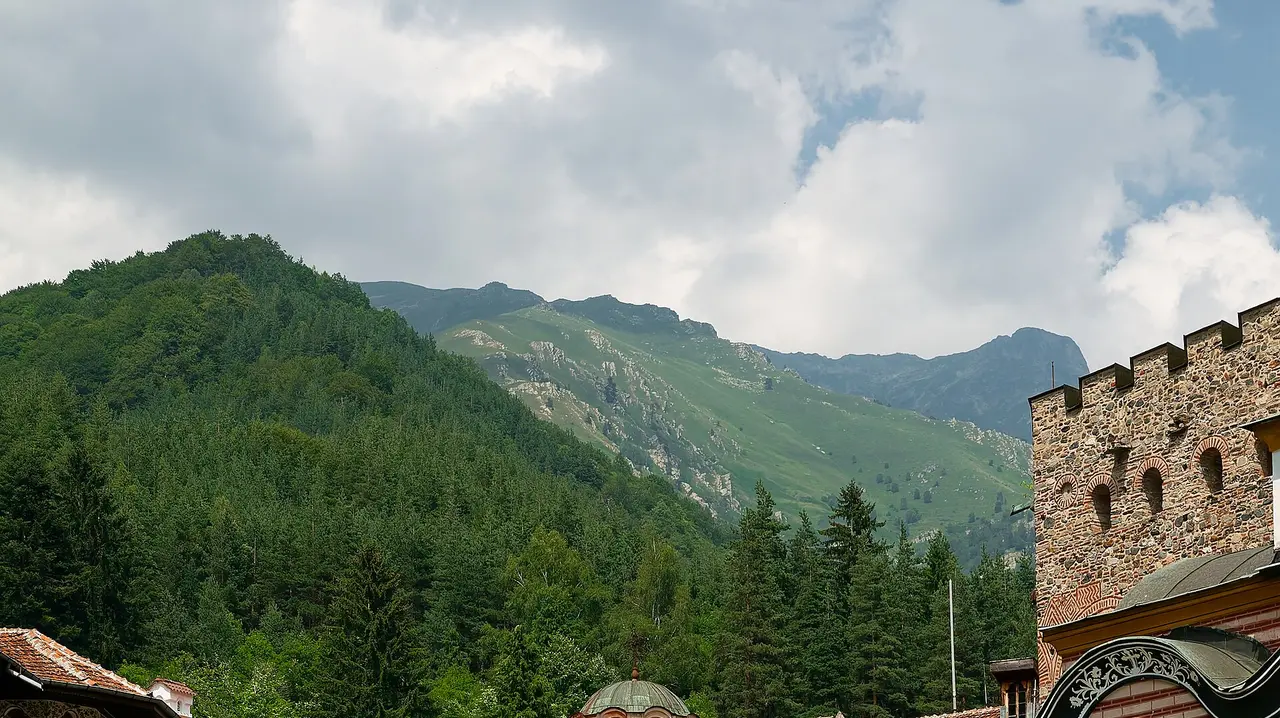
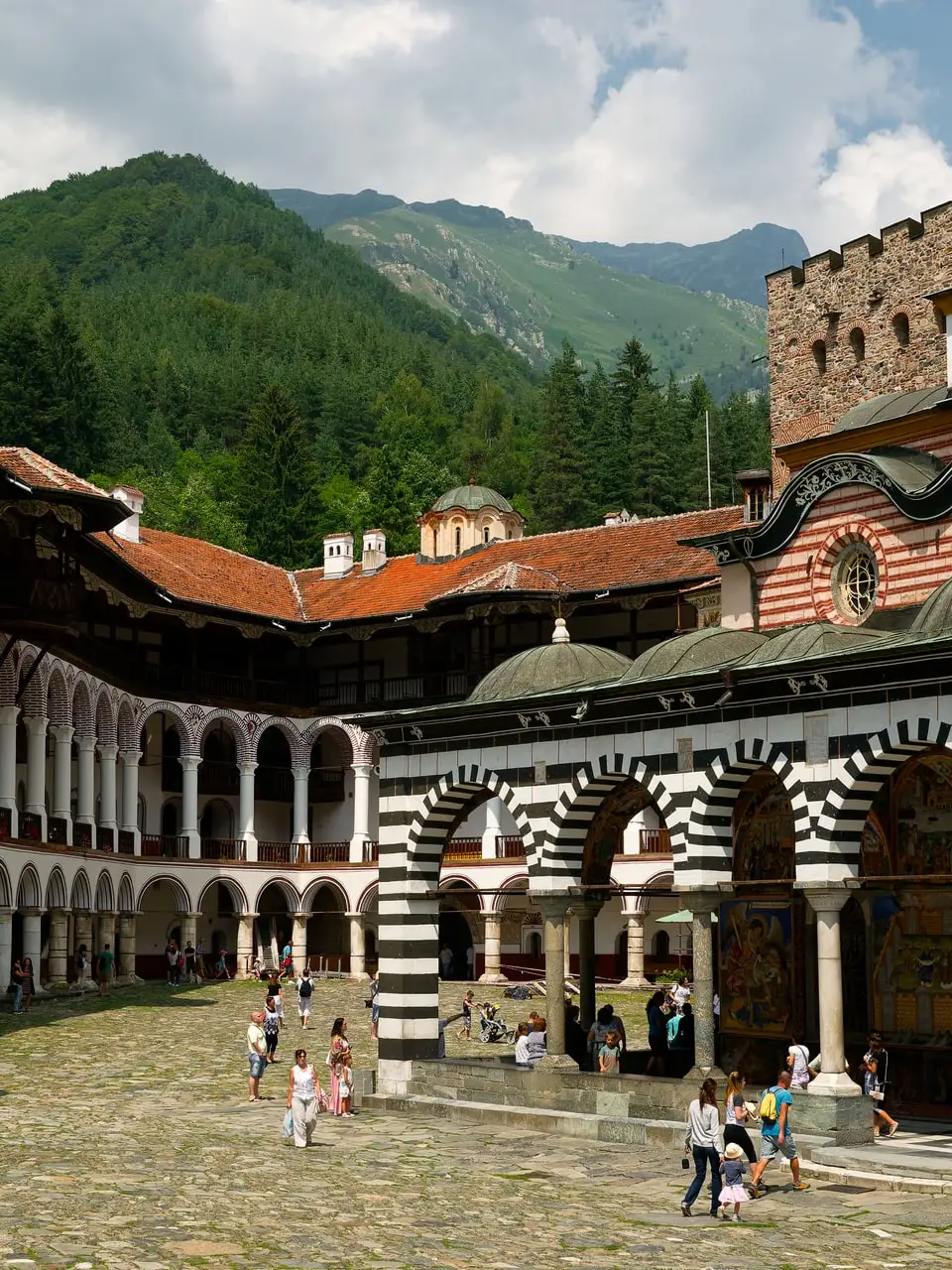
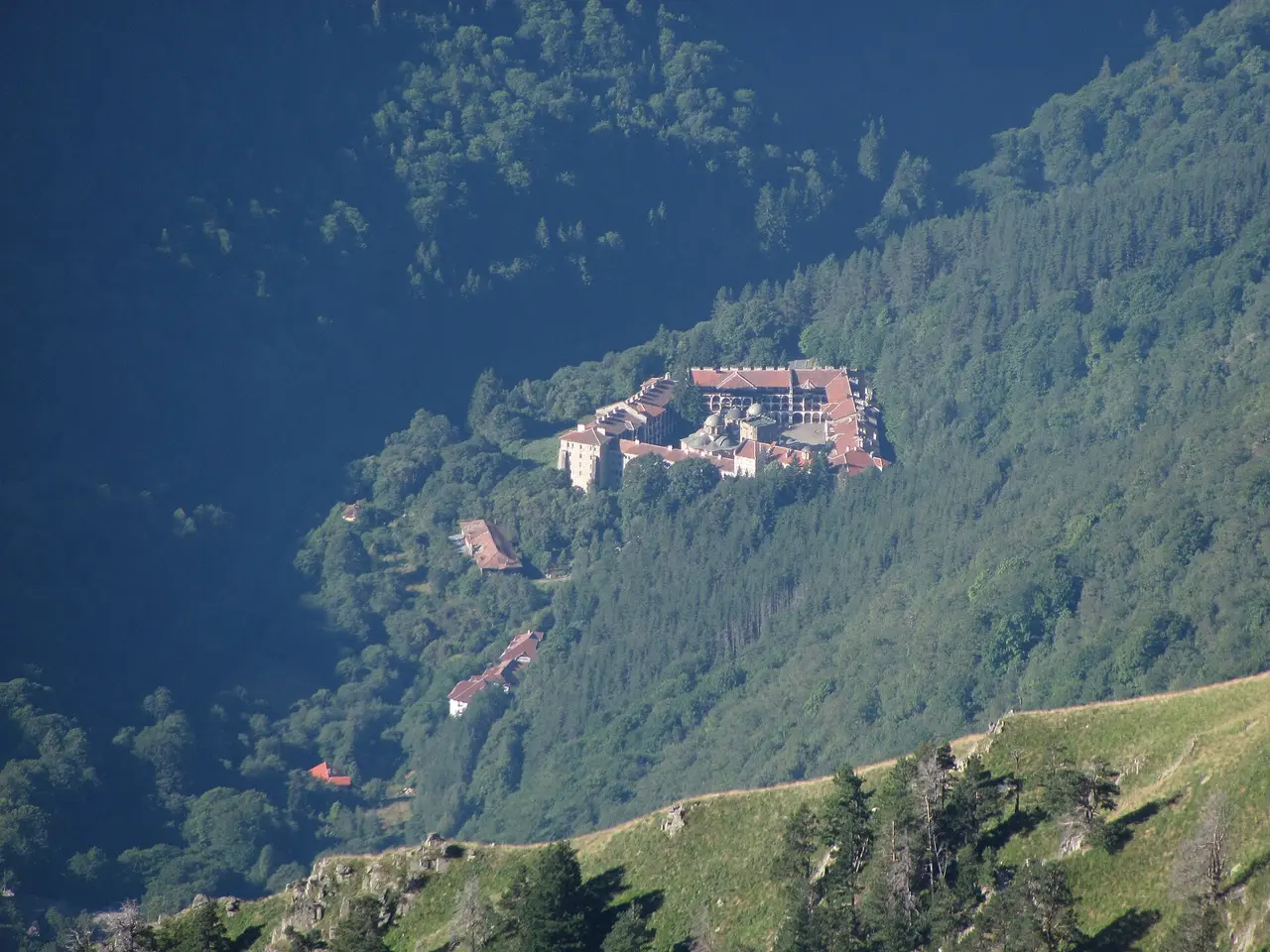
Rila Monastery is a day trip, not an overnight one: it sits about 127 km south of Sofia, roughly two hours away, and the easiest way to reach it without a car is the daily morning shuttle from the city centre. Walking into the complex and its church is free; only the museums charge a ticket. It’s Bulgaria’s most important monastery, a UNESCO World Heritage Site since 1983, and the black-and-white striped arches wrapped around a mountain courtyard are the single most photographed thing in the country.
One honest heads-up up front: the old public bus is unreliable, so don’t build your day around it. Getting there’s really the whole planning problem - once you are inside the walls, the striped arches and the mountain courtyard reward however long you give them.
How do you get to Rila Monastery from Sofia?
Three options, in rough order of how most people do it: an organized shuttle, your own rental car, or (with a big asterisk) public transport. Our dedicated guide to getting from Sofia to Rila Monastery lays out the times, fares and the one-way ticket catch for each.
The daily shuttle is the default for travellers without a car. Traventuria runs one every morning: it leaves central Sofia around 09:00 from the Vasil Levski Monument (in front of the Slovak embassy) and starts back from the monastery at 15:00. Each direction is about 2.5 hours, which leaves you roughly three and a half hours on site, enough for the courtyard, the church, and one museum. Prices start around 15 EUR one-way; book ahead, because these minibuses often sell out. If you would rather have a guide and see a second UNESCO site, there are full day tours that pair Rila with Boyana Church near Sofia from about 25 EUR per person, with guided versions costing more.
Driving yourself buys the most freedom, and the route is genuinely easy. Head south out of Sofia on the A3/E79 motorway toward Blagoevgrad, come off near Dupnitsa/Kocherinovo, then follow road 62 east as it climbs into the Rila mountains. It’s well signed, has no scary mountain passes, and a normal car handles it fine in two to two and a half hours. There’s a paid car park just outside the complex, so keep some cash for it. Driving also lets you stop at the Stob Earth Pyramids, a cluster of strange sandstone spires near the village of Stob on the approach road, worth an hour if the weather is good.
The public bus is the catch. For years there was a single direct “Rila Express” from Sofia’s West/Ovcha Kupel bus station, but it has run patchily at best since the pandemic, and both Free Sofia Tour and the local RilaMonastery.info page currently list it as not reliably operating. The alternative, changing buses through Dupnitsa or Blagoevgrad, eats most of your day. If you’re set on public transport, phone the station to check it’s actually running before you commit; otherwise take the shuttle. Confirm all times and prices on the day, since they shift with the season.
Opening hours and tickets
The complex and the main church are free, and the gate hours move with the week: Monday to Thursday 06:30-18:00, Friday to Sunday 06:30-18:30, and Friday to Sunday until 19:30 from 1 June to 30 September. You can wander the cobbled courtyard, sit under the galleries, and step into the church without paying a lev or a cent. What you pay for is the museum expositions, and the ticket is worth it if you have the time.
A combined museum ticket costs 12 EUR and covers all five exhibits: the Church History Museum (home of the astonishing Rila Cross), the Icon Gallery, the Hrelyo Tower, the “Monastery Economy” museum, and the ethnographic rooms in the old guest quarters. The museums run daily 08:30-16:30 with no day off, extending to 19:30 from 1 June to 30 September. A 50-minute guided tour in English or French is 15 EUR. The monastery prints the figure and nothing else - not whether it covers a group or one person - so ask at the desk before you count on it. Tickets are sold only on the spot at the monastery, with no individual online booking, and cash is the safe bet at the desk. Prices moved to euros when Bulgaria joined the eurozone on 1 January 2026, so double-check the current figure on the day.
If you only do one paid thing, make it the Church History Museum for Rafail’s Cross: a single piece of wood, 81 by 43 centimetres, into which the monk Rafail carved 104 biblical scenes and around 650 tiny figures over roughly twelve years, losing his eyesight in the process. You need the magnifying glass they hand you to see the faces.
What to see inside
Give yourself at least three hours to do the place justice. Here’s what earns your attention.
The Church of the Nativity of the Virgin
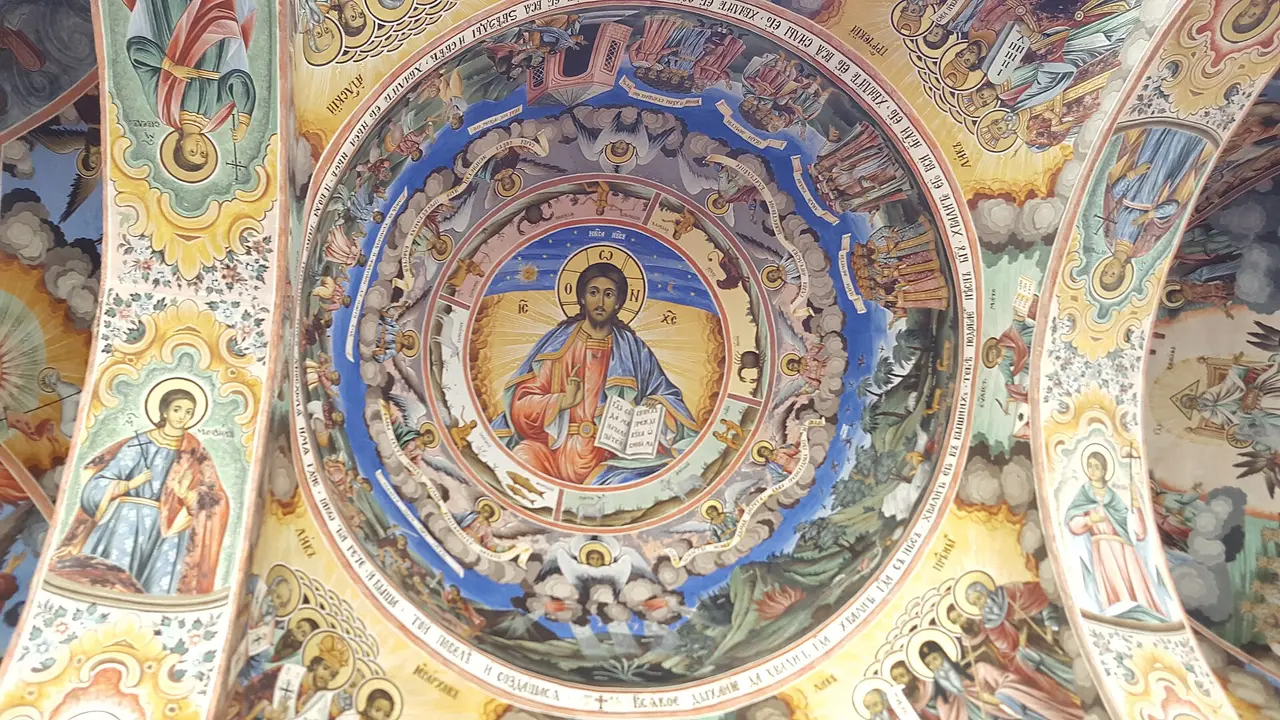
The domed church in the centre of the courtyard is the showpiece, and it’s the newest major part of the complex: built 1834-1837 after a fire destroyed the old monastery, with frescoes finished in 1846 by a team that included the Revival-era master Zahari Zograf and his brother Dimitar. The painted porch is a riot of saints, sinners, and a vivid Last Judgment, all under those striped black-and-white arches. Inside sits a gilded iconostasis that took five years to carve. Dress modestly here (more on that below), keep quiet during services, and look up: the ceiling frescoes are the reason people call this the high point of Bulgarian church painting.
The Hrelyo Tower
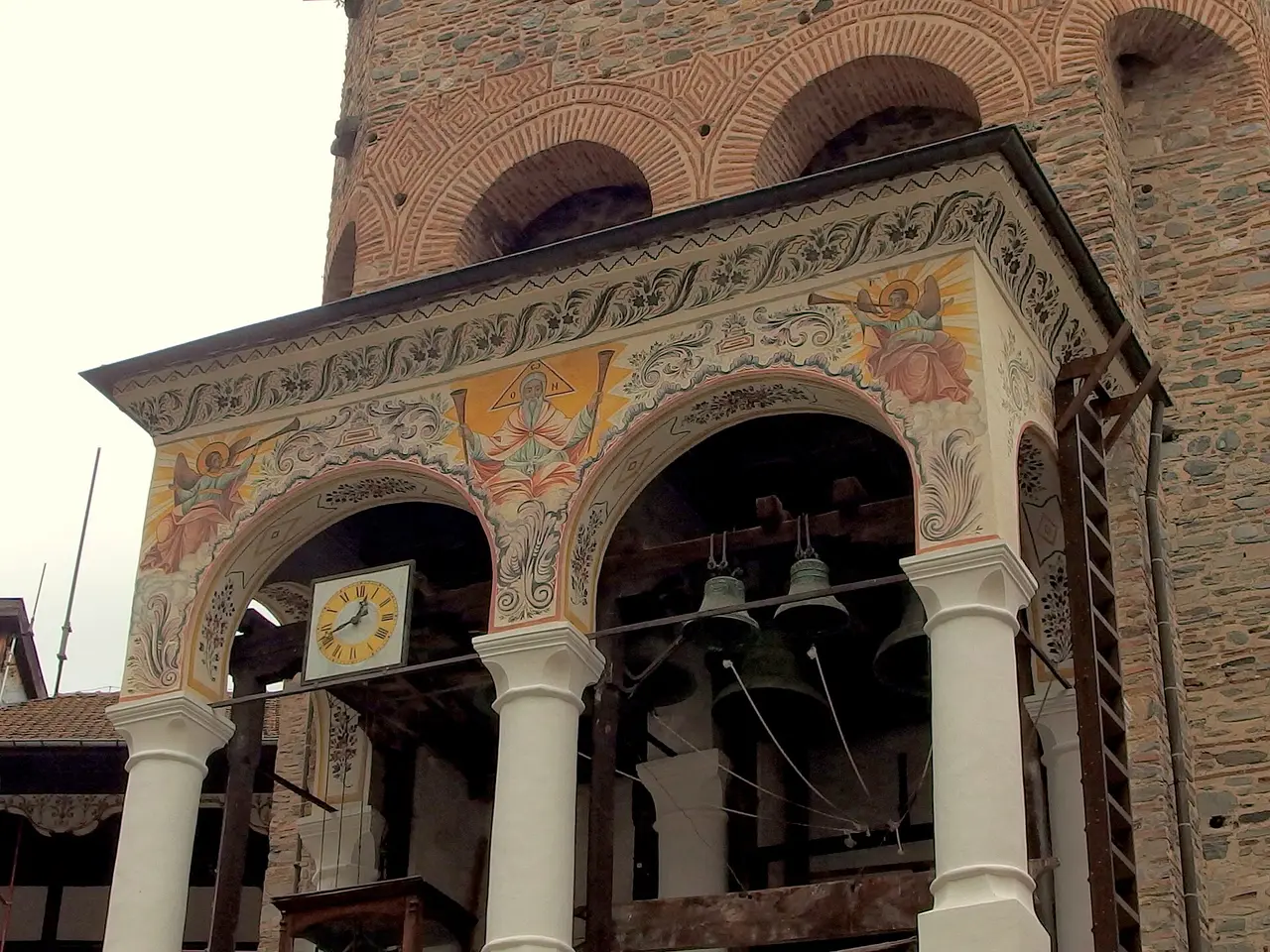
The stone tower is the oldest thing standing here, built in 1334-1335 by the feudal lord Hrelja, and it survived the 1833 fire that took almost everything else. It once served as a keep and a refuge; today you climb it as part of the museum ticket for a chapel with old frescoes and a view down over the roofs and galleries. It’s the clearest reminder that this is a place with 700 years of continuous history, not a 19th-century rebuild.
The galleries and the old kitchen
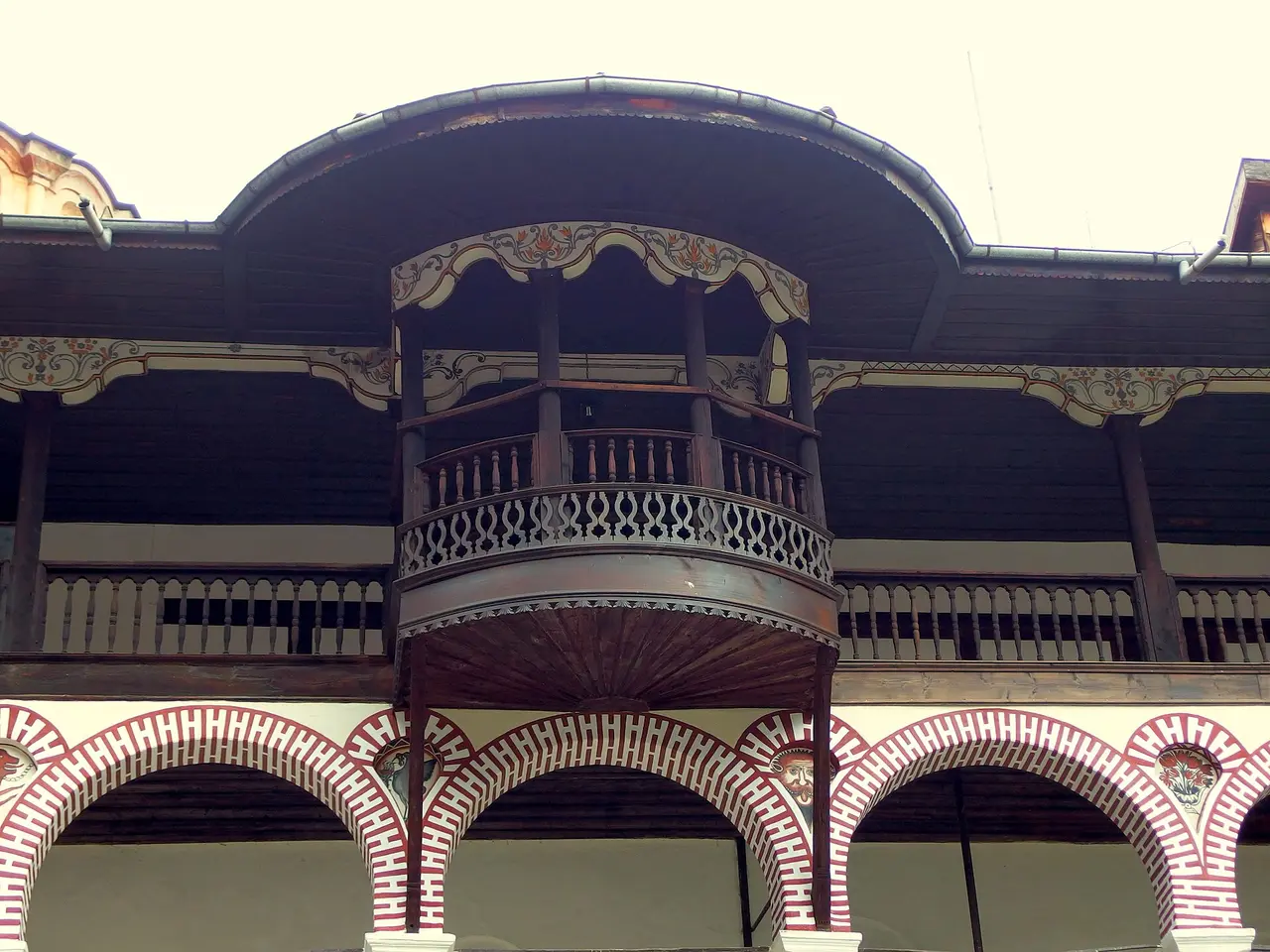
The four-storey residential wings that wrap the courtyard hold around 300 monk cells and layer after layer of arcaded wooden balconies, painted in the same red-and-white patterns as the church. About 60 monks still live here. Tucked into the ground floor is the Magernitsa, the old monastery kitchen, whose cone-shaped chimney rises about 22 metres straight up through all four floors and out the roof, blackened by centuries of cooking for pilgrims. It’s one of the most memorable rooms in the place and easy to miss if you do not look for it.
A short history worth knowing
The monastery goes back to the 10th century and the hermit Saint John of Rila (Ivan Rilski, 876-946), who lived as a recluse in the surrounding mountains and drew followers who founded a monastic community in his name. His relics were brought into the complex in 1469 and are still kept in the church. Through the Ottoman centuries Rila became the beating heart of Bulgarian faith and letters, and it played that role again during the 19th-century National Revival, when the whole country chipped in to rebuild it after the 1833 fire. The reconstruction ran from 1834 to 1862. When UNESCO listed it in 1983, it was recognising exactly this: an unbroken thread of Bulgarian identity running from the Middle Ages to today.
Practical tips
A few things that make or break the visit:
- Dress code is enforced. Shoulders and knees must be covered, and no shorts, vests, or short skirts. If you turn up underdressed, there are free shawls and wraps at the entrance, but it’s easier to plan for it.
- Bring cash. The car park, the museum desk, and the bakery all prefer it, and the desk doesn’t sell tickets online.
- Eat at the bakery. Just outside the courtyard wall, the little bakery sells hot mekitsi (fried dough), fresh bread, and thick buffalo and sheep yoghurt. It is the local move, and cheap.
- Walk to Saint John’s cave. About 3.7 km up the valley (near Kiril Meadow) is the cave where Ivan Rilski lived as a hermit. A short uphill path leads to a narrow gap in the rock that, legend says, only the pure of heart can squeeze through. If you drove, it’s a lovely add-on; on the shuttle you’ll not have time.
- Go early or late. The middle of the day, especially in summer, brings the tour coaches. The first and last hours are quieter and the light on the mountains is better.
Is Rila Monastery worth the day trip?
Yes, and it’s the one excursion from Sofia almost everyone agrees on. The drive up through the Rila mountains is beautiful, the courtyard genuinely lives up to the photos, and free entry to the church and grounds means the only real cost is getting there. Pair it with the Stob Pyramids or Saint John’s cave if you have your own wheels, or keep it simple on the shuttle and spend your time inside the walls.
Planning the rest of your trip? The Seven Rila Lakes sit in the same massif and make a natural second mountain day, though they are a separate valley and a separate trip, not a combined one. If Rila leaves you wanting more monastic art, Bachkovo Monastery, the country’s second-largest, makes the same kind of half-day trip from Plovdiv, and its older, largely unrestored frescoes are a real counterpoint to Rila’s 19th-century rebuild; our monasteries of Bulgaria overview sizes Rila up against the other four worth a day. In winter, the same Rila-Pirin range is where you go skiing in Bansko, an easy pairing if you visit the monastery in the cold months. See our guide to the best things to do in Sofia for the capital you will be based in, browse more of Bulgaria’s top attractions, or fit Rila into a longer loop with our 7-day Bulgaria itinerary. If the mountains are the point rather than the cities, our Rila and Rhodopes route strings the monastery together with the Seven Lakes chairlift, Bansko and the Rhodopes into a week-long drive. If you want the three courtyards in one drive rather than a day trip back to Sofia, the monastery route keeps going south to Rozhen and east to Bachkovo, and drops you in Plovdiv.
Photos
Admission and opening hours
- Admission price
- Complex and church: free. Combined museum ticket: 12 EUR. Guided tour (English/French): 15 EUR - the monastery does not say whether that is per group or per person.
- Opening hours
- Complex and church Monday to Thursday 06:30-18:00, Friday to Sunday 06:30-18:30, and Friday to Sunday until 19:30 from 1 June to 30 September. Museums daily 08:30-16:30, extended to 19:30 from 1 June to 30 Sept, no day off.
Tickets are sold only on-site at the monastery, cash is handy. Confirm current prices and hours on the day.
Details checked: July 24, 2026
Distance ≈117 km · about 2 to 2.5 hours by car
- Sofia ≈117 km · about 2 to 2.5 hours by car South on the A3/E79 motorway, exit near Dupnitsa, then road 62 up into the Rila mountains. Or take a daily shuttle from central Sofia.
Read also

What to see · 13 min read
Skiing in Bulgaria vs the Alps: Honest Verdict
Verified · September 13, 2026Bansko's last published 6-day pass was 341 EUR; Livigno's 2026-27 rate is 374.50 EUR. Real lift-pass, terrain and rental numbers, checked Sep 2026.

What to see · 12 min read
Pirin National Park: Vihren, Trails & Lakes
Verified · September 3, 2026Pirin National Park: the Vihren hut road closure, UNESCO peaks, 27 marked trails, glacial lakes and Bansko visitor centre hours.

What to see · 12 min read
Climbing Musala: The Balkans' Highest Peak
Verified · August 29, 2026Climbing Musala, the Balkans' highest peak at 2,925 m: the Yastrebets gondola schedule and price, the real hiking time from the top station, huts and gear.

What to see · 9 min read
Learning to Ski in Bansko: Schools & Lessons
Verified · August 25, 2026Bansko ski lessons: group and private prices in euros from official schools, Banderishka Polyana base, plus the lift pass you still need. Checked 2026.