
Plovdiv Roman Theatre and Ancient Sites
A guide to the Roman Theatre of Philippopolis in Plovdiv: its history, seeing a show, tickets and hours, plus the stadium, forum and basilica mosaics.
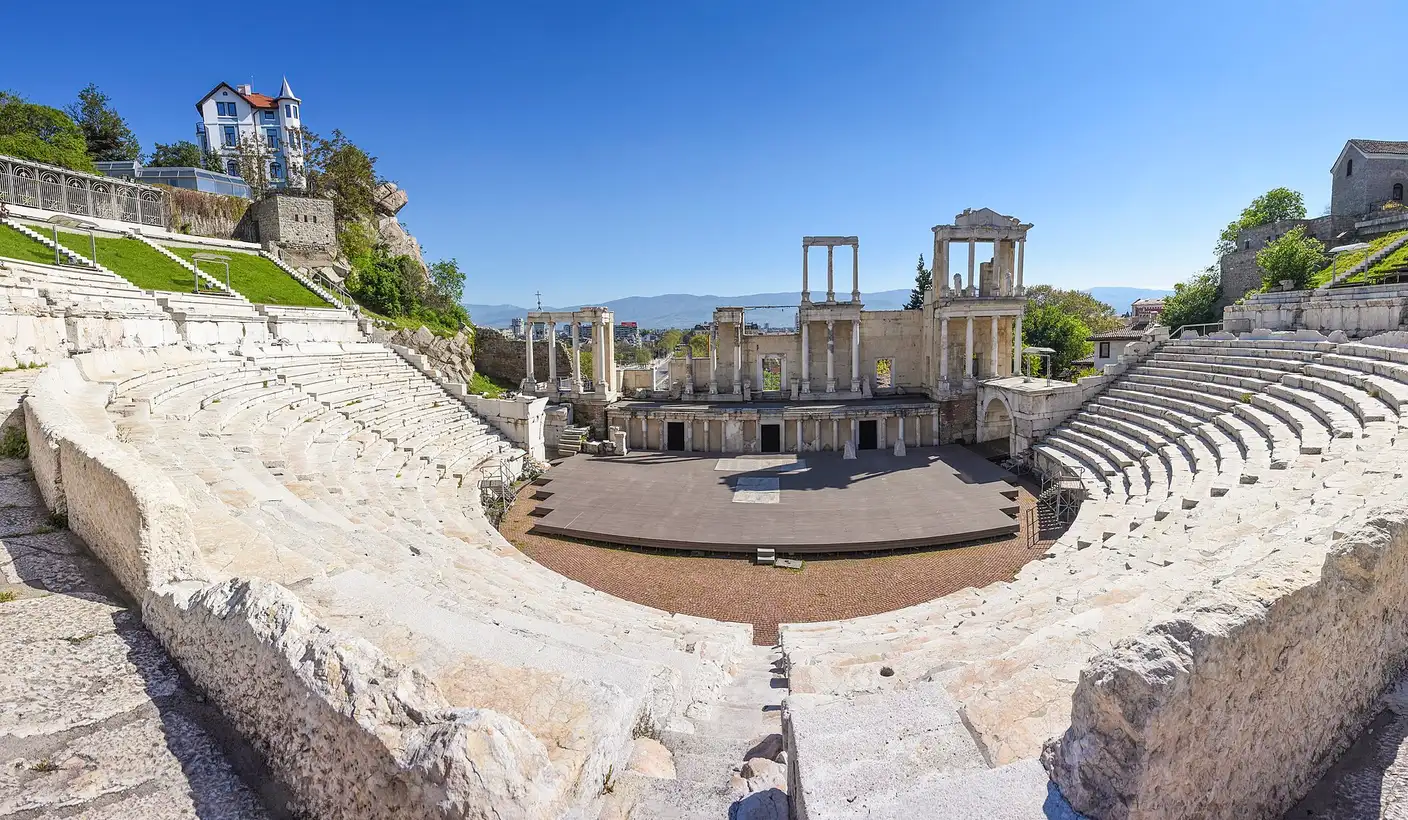
The Ancient Theatre of Philippopolis is the reason most people climb Plovdiv’s old-town hills, and it earns the walk: a marble Roman theatre from the early 2nd century AD, cut into the saddle between two hills, so well preserved that it still stages opera and concerts every summer. A daytime ticket costs about 2.56 euro (5 leva), it seated somewhere between 5,000 and 7,000 people, and the Rhodope mountains fill the gap behind the stage. But the theatre is only the headline of a whole Roman city buried under modern Plovdiv, so this guide covers the theatre in full, then the stadium under the shopping street, the forum and odeon, and the vast late-Roman basilica with 2,000 square metres of mosaic floors, enough for a proper day among the ruins.
The short version
- What: the best-preserved Roman theatre in Bulgaria, built about AD 108-114, still a working venue.
- Ticket: roughly 2.56 euro (5 leva) adult, about 1 euro for students; open daytime, roughly 09:30-18:00 April to October, shorter in winter, sometimes closed on show days.
- Also see nearby: the Roman Stadium at Dzhumaya Square (free to view), the Roman Forum and Odeon by the central square, and the Bishop’s Basilica mosaics.
- Time needed: 30-45 minutes for the theatre, half a day to walk the full Roman circuit.
History: a theatre lost, then found in a landslide
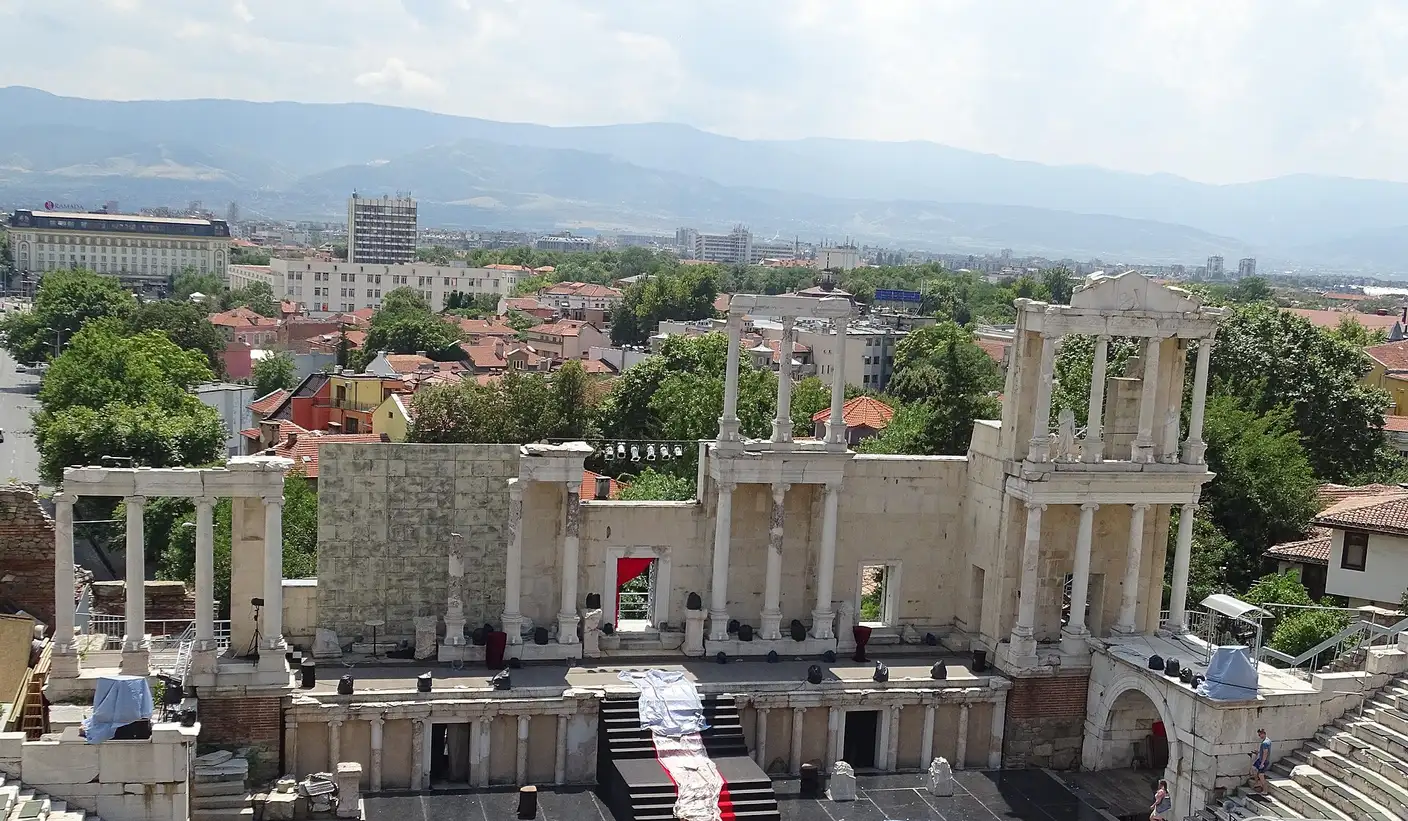
The theatre was built when Philippopolis, the Roman name for Plovdiv, was a thriving provincial capital. A builder’s inscription dates the main phase to the reign of Emperor Trajan, around AD 108-114, though a Greek inscription found in 2016 hints that work may have been planned earlier, under Domitian. For centuries afterwards it was simply lost: buried under earth, later houses and the slow burial of time, its existence half-forgotten.
What brought it back is the good part. A major landslide in 1972 tore away part of the old-town hillside and exposed rows of marble seating, and the Plovdiv Archaeological Museum’s systematic excavation, carried out across 1968 to 1979, uncovered the whole structure. It was then painstakingly restored and, rather than being fenced off as a relic, handed back its original job as a place to watch a show. That’s the detail worth holding onto as you look at it: this isn’t a reconstruction or a museum mock-up, but the real 2nd-century theatre, dug out of a landslide within living memory and put back to work.
What you are looking at
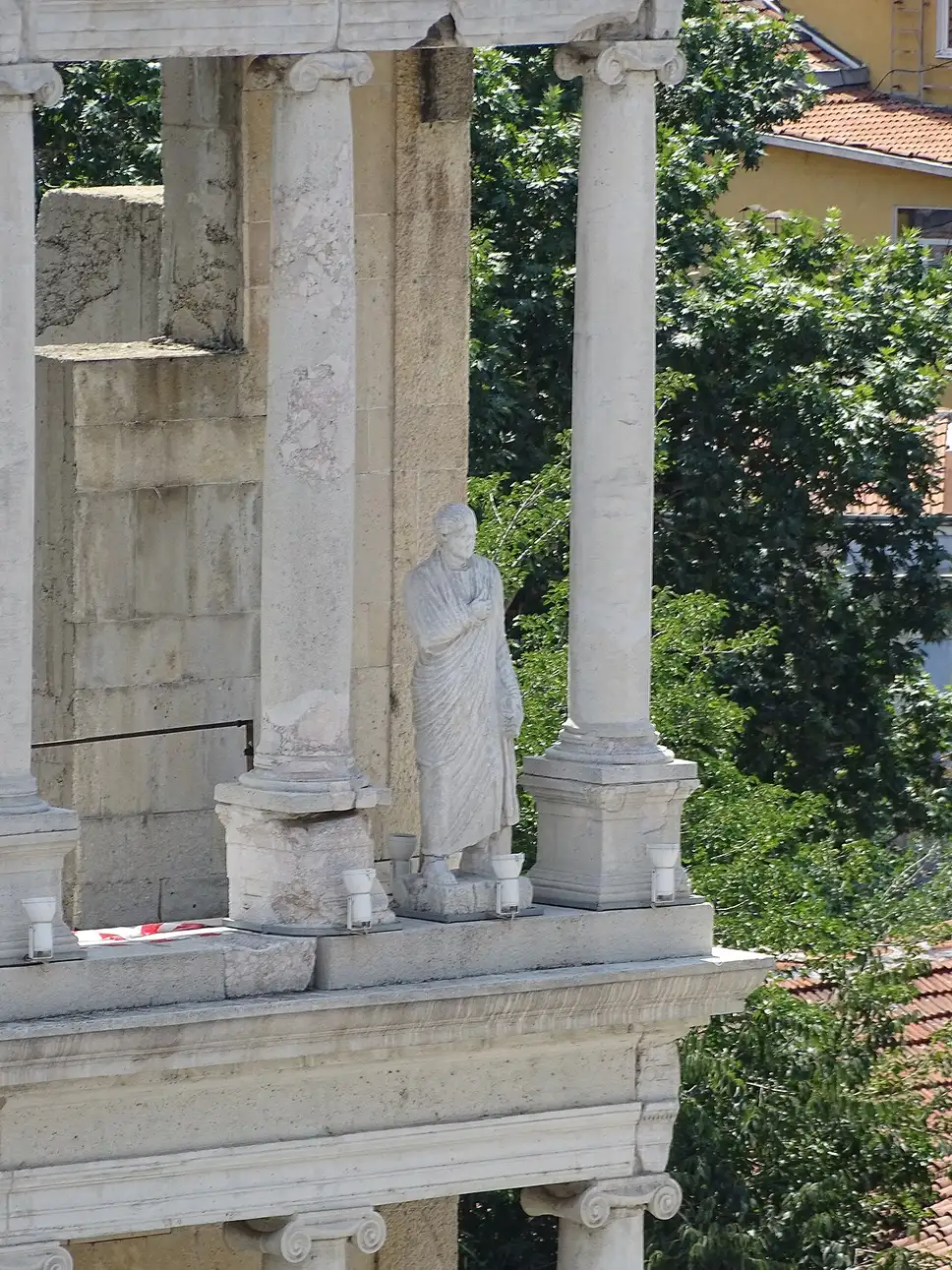
The theatre uses the Roman template but sits in a spectacular natural seat. The semicircular cavea, the bank of seating, curves through the saddle between Taksim Tepe and Dzhambaz Tepe, two of Plovdiv’s hills, so the slope did half the builders’ work. Its marble rows, which held 5,000 to 7,000 spectators, were divided into wedge-shaped sections, and inscriptions carved into the seating record the districts of the ancient city they were reserved for, a stone seating plan for a Roman crowd. Facing the audience is the scaenae frons, the tall columned stage building, partly re-erected, with statues and a pediment, and beyond it the land drops away to the rooftops of the modern city and the blue line of the Rhodopes. It’s one of the great views from any ancient theatre, and it’s free with your seat.
Seeing a show, not just the stones
Here’s the insider move: if your dates allow, don’t just visit the theatre, sit in it for a performance. The summer Opera Open season, run by Plovdiv’s opera house, stages opera, ballet, musicals and big concerts on the ancient stage from roughly late June into early September, and watching a production here, with the lit columns behind the singers and the warm night over the Rhodopes, beats any daytime photo. Tickets for events are sold separately from the sightseeing entry, and on performance days the theatre often closes to normal daytime visits while crews set the stage, so if you only want the daytime look, check before you climb. Either way, it is worth timing your trip around the calendar if you can.
Visiting: tickets, hours and how to get in
For an ordinary daytime visit the theatre is inexpensive. Official rates are about 5 leva (2.56 euro) for an adult, 2 leva (about 1 euro) for students, and 10 leva (about 5.11 euro) for a family of parents with children aged 7 to 16; a guided tour runs 15 leva. The theatre’s rates page still lists both currencies, though Bulgaria adopted the euro in January 2026 and mandatory dual display ended on 8 August 2026, so the board on the day may show euro only; a handful of third-party sites quote higher figures, so treat these as a guide and confirm at the desk. Opening hours are seasonal, roughly 09:30 to 18:00 from April to October and about 09:00 to 17:30 in winter, with the performance-day caveat above.
Getting to it’s a short, steep walk. The theatre sits above the main pedestrian street; the easiest approach is up through the Old Town from Dzhumaya Square, and the entrance is signposted off Tsar Ivaylo Street. Wear shoes with grip, because the old-town cobbles are steep. The theatre features as the star sight in our wider guide to the best things to do in Plovdiv, which sequences it with the museum-houses and Nebet Tepe on a single walk.
The Roman Stadium under the shopping street
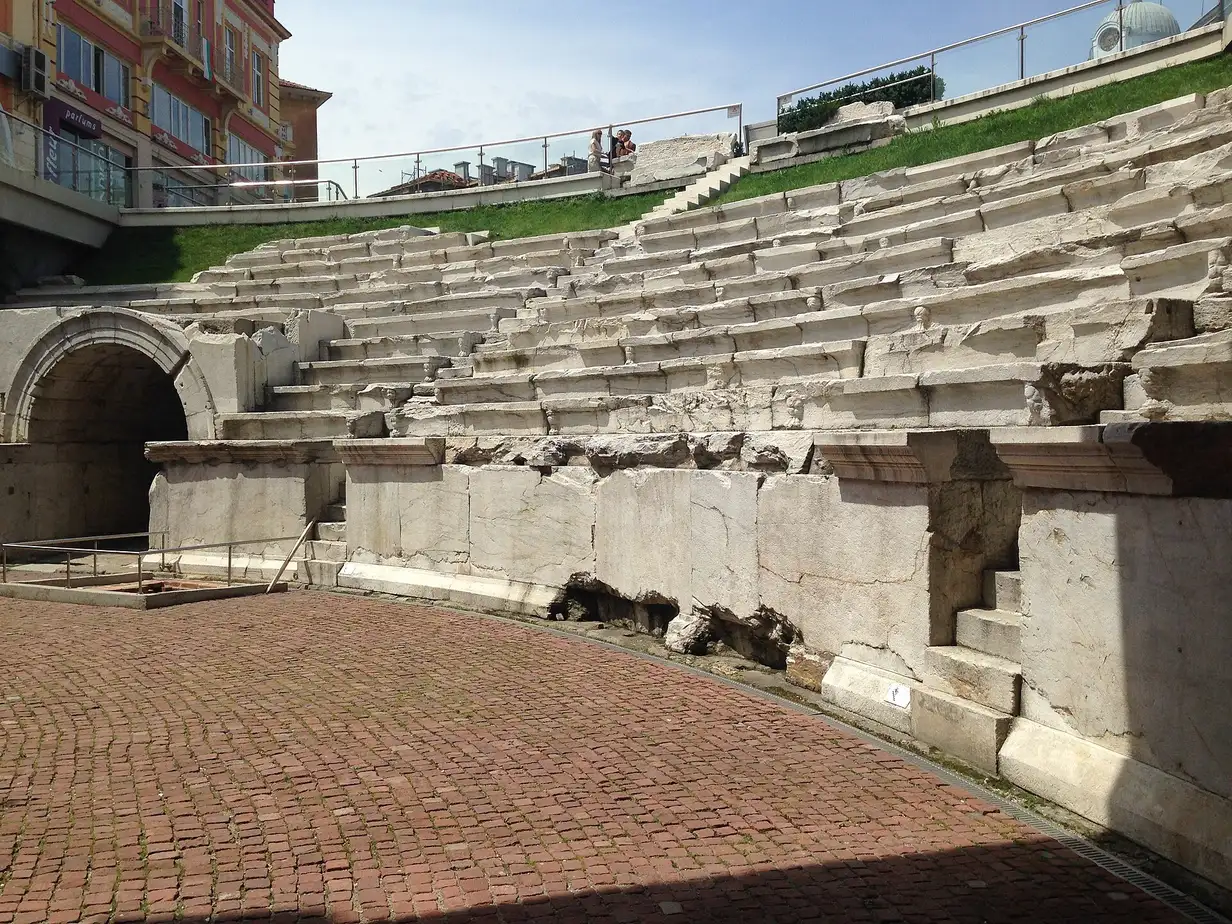
Plovdiv’s second great Roman sight is one you can stumble into for free. Walk the pedestrian shopping street and at Dzhumaya Square the pavement drops away into a sunken pit of curved marble seating: this is the sphendone, the rounded northern end of the Stadium of Philippopolis, built in the 2nd century AD under Emperor Hadrian. The rest of the track, some 240 metres of it, still runs under the modern street beneath your feet, and in its day the stadium held crowds of up to 30,000 for athletic games modelled on those at Delphi. You can look down into the exposed end from the square at any time of day or night at no charge; a small covered section, reached by an underpass and sometimes showing a short 3D film about the games, keeps its own hours and a modest fee.
The Forum and the Odeon
Less visited but worth seeking out is the civic heart of Roman Philippopolis. Near the central square and the main post office lie the excavated remains of the Roman Forum, once the city’s commercial and administrative hub, ringed by shops and public buildings. At its northern end sits the Odeon, a small roofed theatre that doubled as the bouleuterion, the meeting house of the city council, built over several phases from the 2nd century AD and partly reconstructed. It’s a quieter, more intimate cousin of the great theatre up the hill, and together they show how a Roman provincial capital actually ran, one stage for spectacle, one chamber for government.
The Bishop’s Basilica and its mosaics
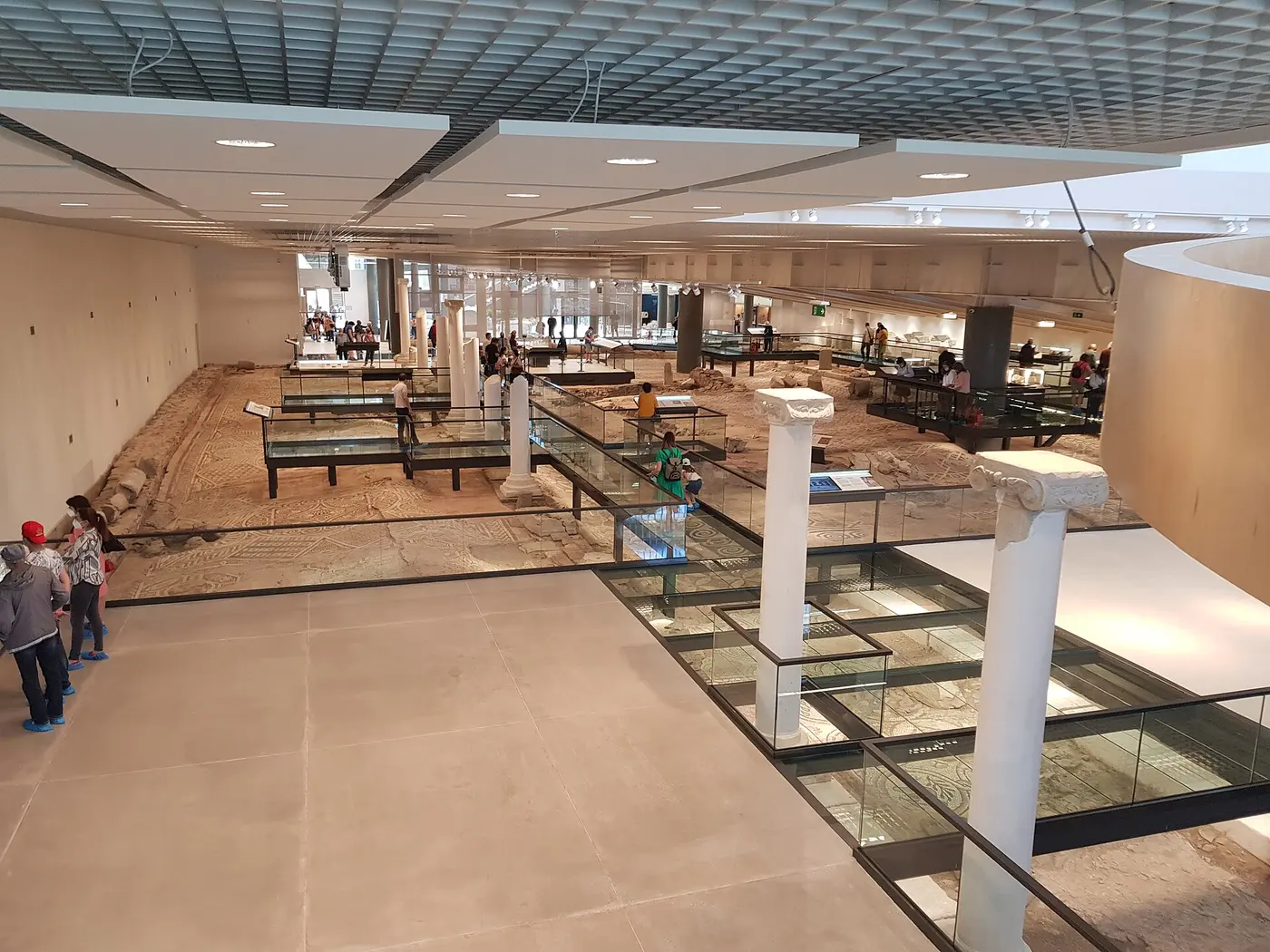
The newest reason to linger is the late-Roman Bishop’s Basilica of Philippopolis, sometimes called the Great Basilica, built in the mid-4th century AD as Christianity took hold. At roughly 82 by 36 metres it was the largest basilica of its era in Bulgaria and one of the biggest in the Balkans, and its glory is the floor: around 2,000 square metres of mosaics, laid in layers, patterned with birds and geometric panels. After a long restoration it now shelters under a modern museum building that lets you walk on glass above the ancient floors. With the nearby Small Basilica and the Eirene building, both also mosaic-floored, it forms a mosaic heritage that Bulgaria has put forward for UNESCO World Heritage listing (currently on the tentative list). If the theatre is the drama of Roman Plovdiv, these floors are its quiet masterpiece.
Making a day of Roman Plovdiv
The beauty of it’s how tightly the sights cluster: the theatre, stadium, forum, odeon and basilica are all within about 15 minutes of each other on foot around the old-town hills, so you can string them into a single unhurried half-day and still have the afternoon for the museum-houses and a coffee in Kapana. Most visitors reach Plovdiv from the capital, about 143 km on the A1 motorway, roughly an hour and a half by car or two hours by bus; our guide on getting from Sofia to Plovdiv covers the train, bus and drive, and a fixed-price transfer from Sofia Airport takes the guesswork out if you’re arriving with luggage. With more time, Plovdiv is also the base for the Valley of Roses around Kazanlak and links north to Veliko Tarnovo on our Plovdiv to Veliko Tarnovo route. To catch the theatre at its best, aim for the shoulder months our best time to visit Bulgaria guide recommends, when the light is good and the Opera Open stage comes alive.
Admission and opening hours
- Admission price
- Ancient Theatre (euro, from official rates): adult 5 leva / about 2.56 euro; student 2 leva / about 1.02; family (parents with children 7-16) 10 leva / about 5.11; guided tour 15 leva / about 7.67. The Roman Stadium curve is free to view from Dzhumaya Square.
- Opening hours
- Theatre roughly April to October daily 09:30-18:00; November to March about 09:00-17:30. It can close early or shut to daytime visitors on performance days.
Prices from the official rates page of the theatre, which lists them in leva and euro (5 BGN / 2.56 EUR adult); Bulgaria joined the euro on 1 January 2026 and mandatory dual leva/euro display ended on 8 August 2026, so the board on the day may be euro-only. Some third-party sites list higher fees, so reconfirm at the ticket desk on the day.
Details checked: July 16, 2026
Read also

What to see · 13 min read
Skiing in Bulgaria vs the Alps: Honest Verdict
Verified · September 13, 2026Bansko's last published 6-day pass was 341 EUR; Livigno's 2026-27 rate is 374.50 EUR. Real lift-pass, terrain and rental numbers, checked Sep 2026.

What to see · 12 min read
Pirin National Park: Vihren, Trails & Lakes
Verified · September 3, 2026Pirin National Park: the Vihren hut road closure, UNESCO peaks, 27 marked trails, glacial lakes and Bansko visitor centre hours.

What to see · 12 min read
Climbing Musala: The Balkans' Highest Peak
Verified · August 29, 2026Climbing Musala, the Balkans' highest peak at 2,925 m: the Yastrebets gondola schedule and price, the real hiking time from the top station, huts and gear.

What to see · 9 min read
Learning to Ski in Bansko: Schools & Lessons
Verified · August 25, 2026Bansko ski lessons: group and private prices in euros from official schools, Banderishka Polyana base, plus the lift pass you still need. Checked 2026.