
Thracian Tombs of Kazanlak: UNESCO & Valley of Kings
The Thracian tombs around Kazanlak: why you visit a replica, which royal mounds are open daily, where the gold is kept, and how to plan a day.
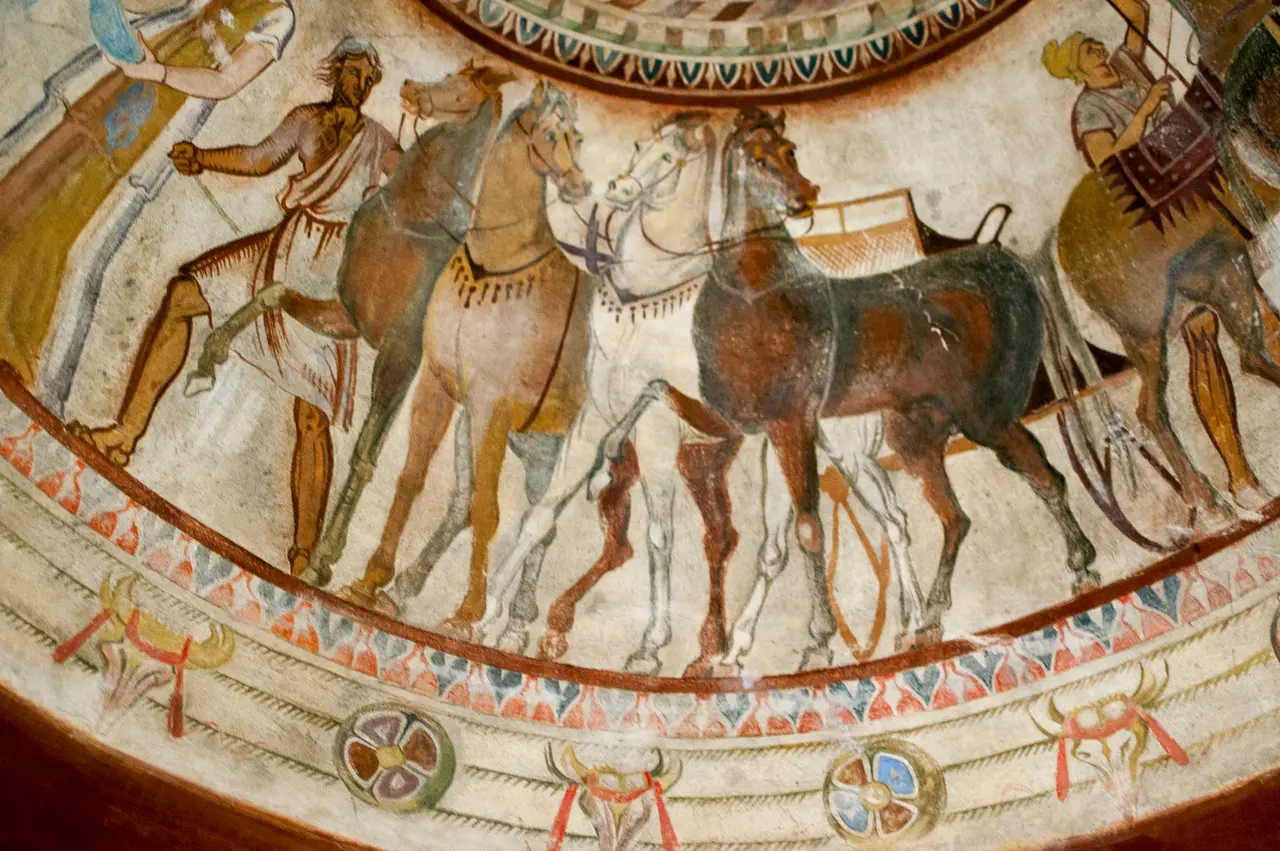
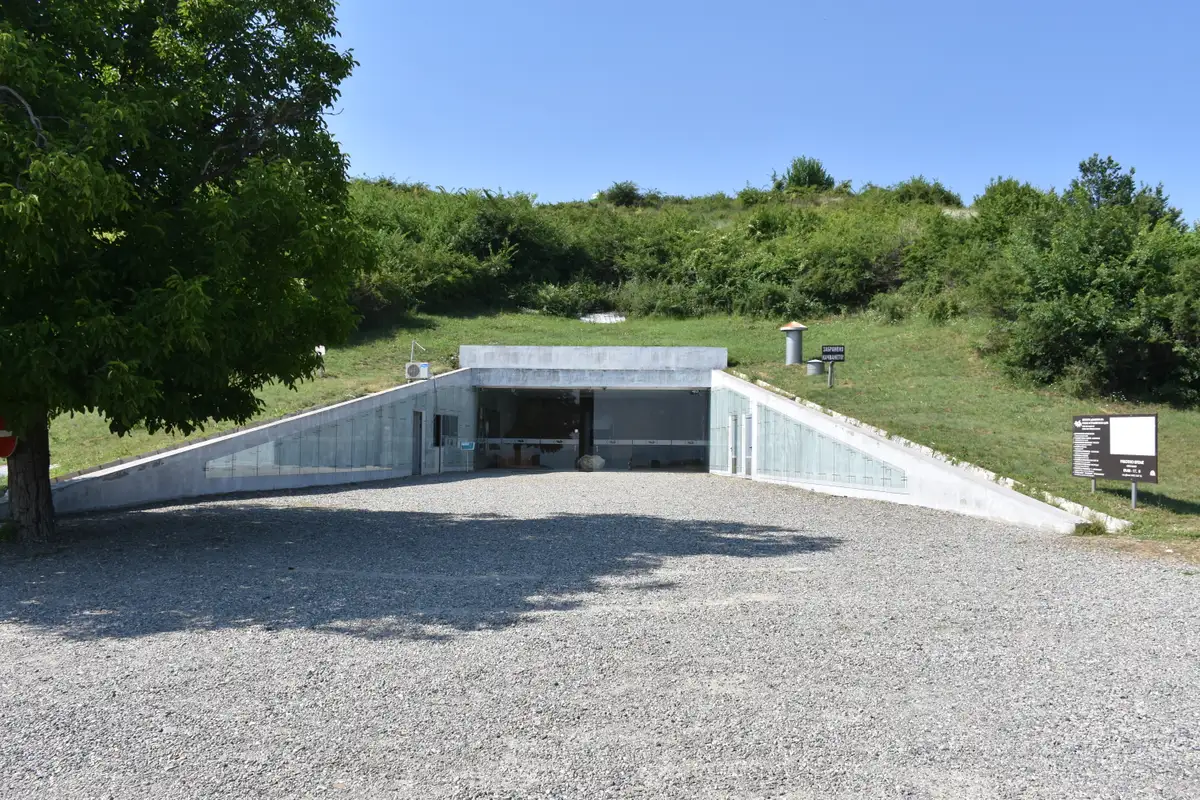
The famous painted tomb at Kazanlak is sealed, and what you walk into is a full-size replica built beside it. That’s the single fact to get straight before you go, because nothing on the road signs says so, and people arrive expecting to stand inside a UNESCO monument from the 4th century BC. The replica is honest, precise and worth the ticket. The originals of this valley, though, are elsewhere, and several of them you really can enter.
Kazanlak sits in what Bulgarians call the Valley of the Thracian Kings, a stretch of the Rose Valley holding more than a thousand burial mounds around the drowned royal city of Seuthopolis. Six of those tombs are open to the public every day, the tomb of a named king among them, complete with a marble door and a 60-tonne monolith carved into a burial chamber. Almost nobody outside Bulgaria has heard of them, which is why you’ll often have a royal tomb to yourself on an August afternoon.
The UNESCO tomb, and why you see a copy
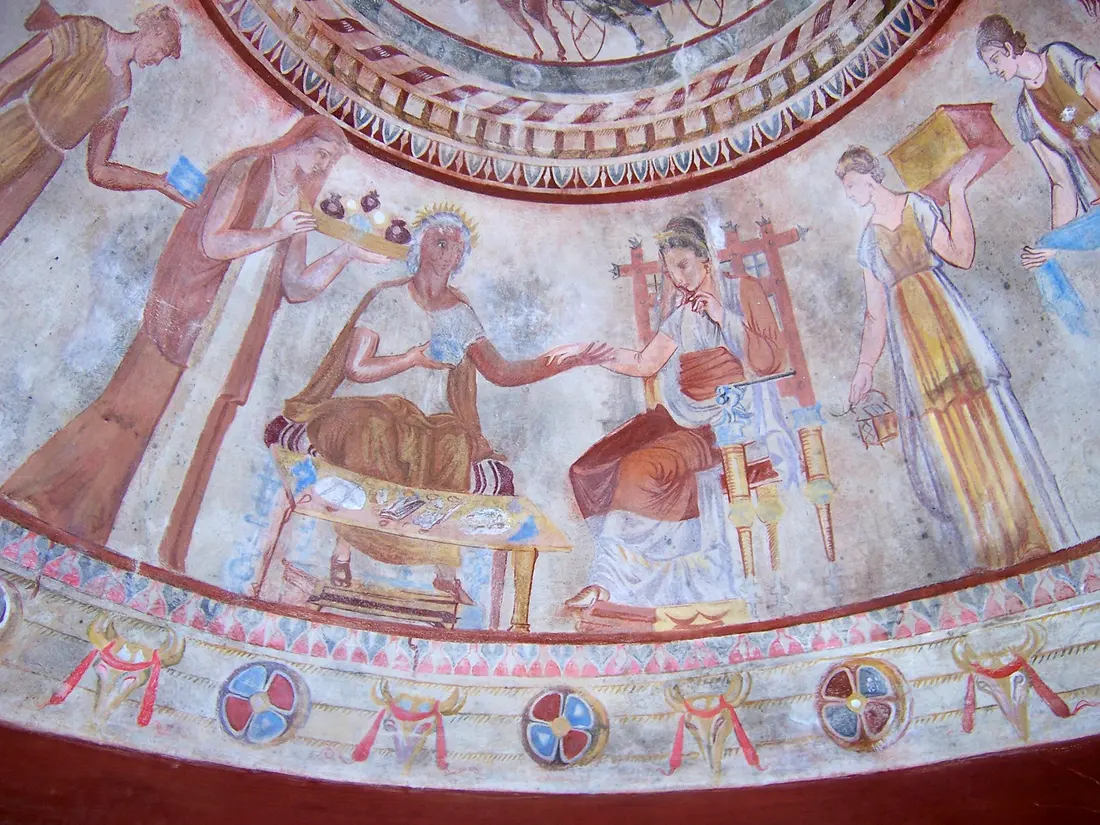
Soldiers stumbled into it in 1944 while digging an air-raid shelter, and by 1979 it was on the UNESCO World Heritage list. What they had broken into was a burial from the closing decades of the 4th century BC: a low passage, a small rectangular anteroom, and beyond it a circular chamber roofed by a corbelled beehive vault. Around that vault runs the scene the tomb is famous for, a seated couple, ruler and consort, clasping one another at the wrist over a funerary meal while grooms, horses and a racing chariot wheel overhead. Only four pigments do the work, black, red, yellow and white, and nothing else from Hellenistic Bulgaria survives at this quality.
Breath, body heat and humidity are precisely what kills that kind of surface, so the museum has an order in force suspending access to the original. The replica next door in Tyulbeto park reproduces the chamber at full scale, and it opens daily 09:00 to 17:00. Twenty minutes covers it, but stand there longer than that; the details reward it, particularly the pair at the centre and the way the painter handled the horses.
Golyama Kosmatka: a king with a name
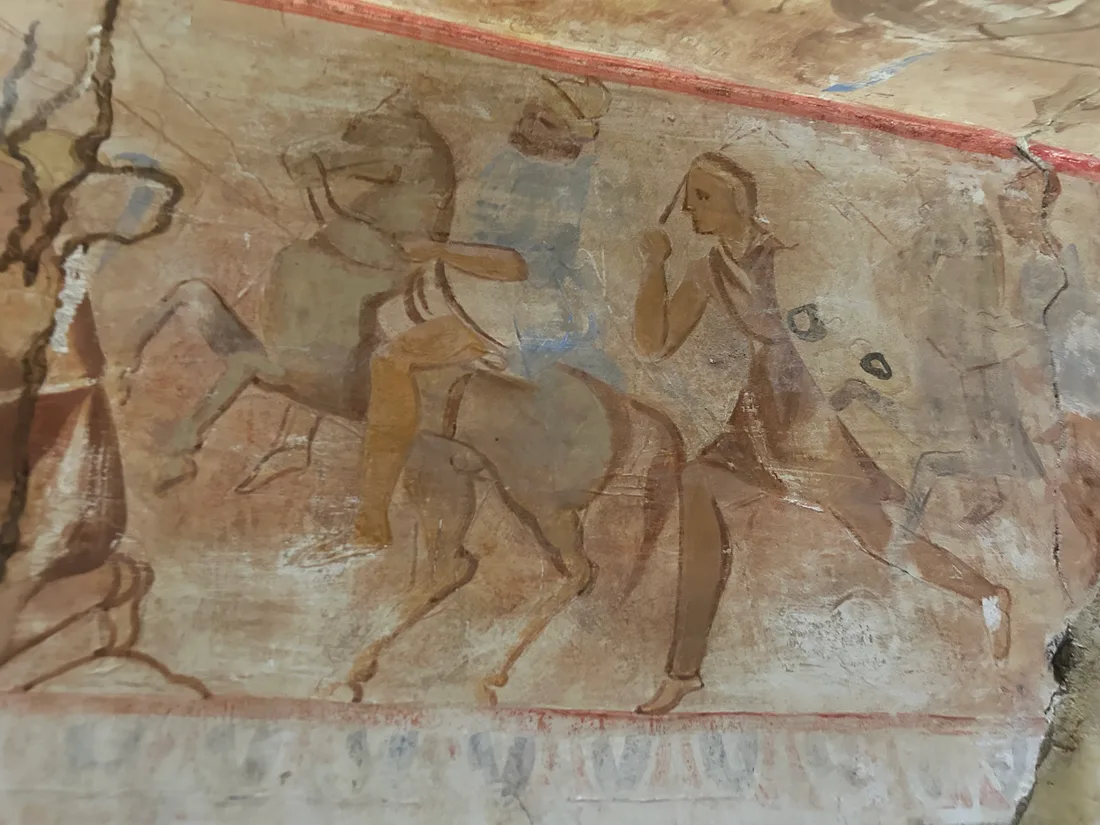
This is the one to prioritise if you only add a single stop. On 21 September 2004, the archaeologist Georgi Kitov and his team opened the Golyama Kosmatka mound and found a tomb built for a specific, identifiable person: Seuthes III, the Odrysian ruler who founded Seuthopolis.
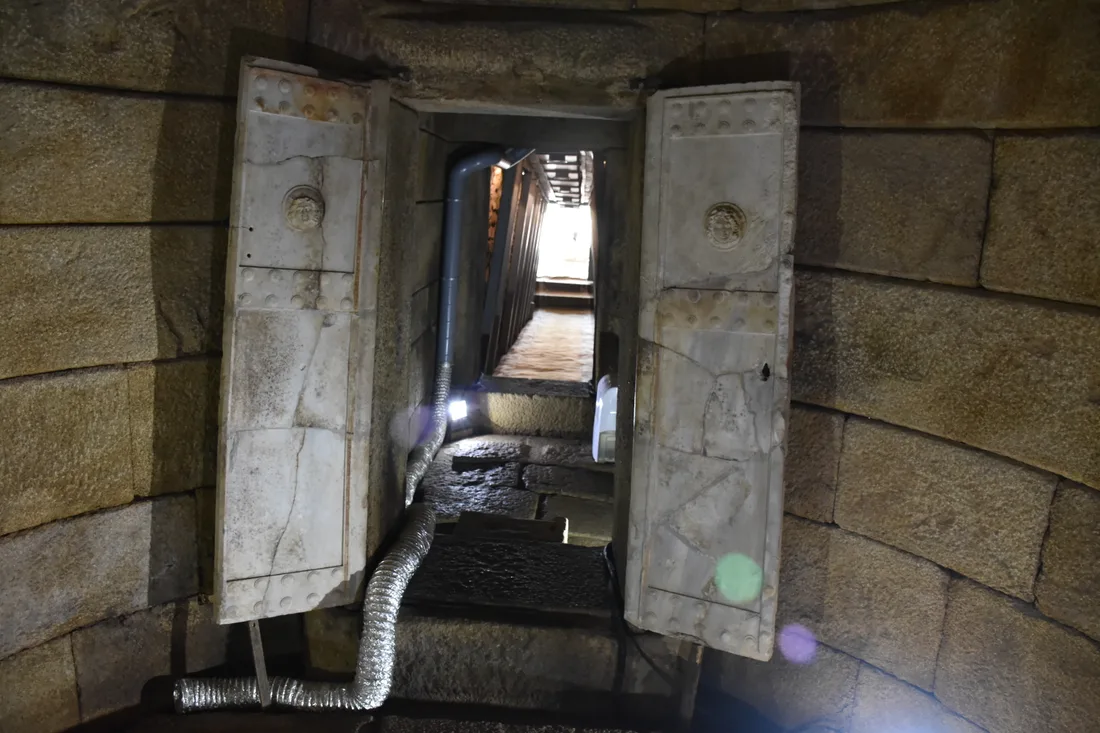
The architecture alone justifies the trip. A corridor runs 13 metres into the mound, past two antechambers, the second of them round beneath a cupola 4.5 metres high and closed by a marble door carved with medallions of Helios and Medusa. Behind that, the burial chamber isn’t built but hewn, cut out of a single block of stone weighing something like 60 tonnes. Inside, excavators recovered more than 20 gold objects and around 70 more in silver and bronze, along with a gold wreath and a bronze portrait head, nearly life-size, its eyes made from glass paste and ground alabaster and its lashes and brows picked out in thin copper strips. Four bronze coins of Seuthes III lay at the start of the corridor, and the face on them matches the face of the head.
Where the treasure actually is
Worth knowing before you plan, because it catches people out. The bronze head of Seuthes III is in Sofia, held by the National Archaeological Institute with Museum, and it travels to big international exhibitions. The gold wreath and the rest of the grave goods are in Kazanlak, in the Iskra History Museum in the town centre, which is open daily 09:00 to 17:30.
So a Kazanlak day gets you the tombs as architecture plus the gold; a Sofia visit gets you the single most famous Thracian object in the country. If the head is the thing you’ve come for, plan a stop in the capital rather than driving 170 km expecting to find it in the valley. The museums are honest about this, but the guidebooks blur it.
Ostrusha, and the other four open mounds
Six sites in the valley are open daily 09:00 to 17:00, and the two most striking after Golyama Kosmatka are Ostrusha and Shushmanets.
Ostrusha, excavated by Kitov in 1993 near the town of Shipka, is the strangest structure in the valley. Under a mound over 18 metres high sits a complex of six rooms covering about 100 square metres, and the surviving chamber was carved out of two solid granite blocks weighing more than 60 tonnes together, with the roof cut into the shape of a Greek temple. The ceiling is divided into coffers, each once painted; most are wrecked, but one survives almost intact, the portrait of a young noblewoman with long brown hair, gold earrings and a gold necklace, painted in the middle of the 4th century BC. One unlooted room held a horse buried with silver harness fittings, a gilded armour collar and two silver vessels.
Shushmanets, Helvetia and the Griffins mound complete the open set, and Shushmanets is the one to add if you have an hour spare. Kitov found it in 1996, also near Shipka and about 200 metres northeast of Helvetia; it dates from the 4th to 3rd century BC and it’s a tomb-temple rather than a plain burial chamber. A wide corridor leads to an antechamber roofed with a half-barrel vault carried on an Ionic column, then into a round tholos whose vault rests on a polished Doric column topped by a large disc, generally read as the sun. The whole thing, walls, floors, ceilings, columns and door, is built from hand-worked biotite granite. Nobody needs all six mounds in one day. Two or three is a good afternoon; five is a slog.
One more thing that says something about how the valley is regarded at home: Bulgaria has put the whole royal necropolis of Seuthopolis on the UNESCO tentative list as a proposed serial extension of the single Kazanlak tomb. Whether that ever goes through is anyone’s guess, but it tells you these mounds aren’t a provincial afterthought.
Seuthopolis, the capital at the bottom of a lake
The city these kings ruled from is still here, and you can’t see any of it. Seuthes III founded Seuthopolis between 325 and 315 BC as the capital of the Odrysian kingdom: a compact fortified town of about 5 hectares, its walls 890 metres around and 2 metres thick. Archaeologists found it in 1948 during work on a water scheme, were given six years to excavate, and then the valley was flooded. Seuthopolis has been under the Koprinka reservoir ever since.
In 2005 the architect Zheko Tilev proposed rescuing it with a circular dam wall 420 metres across, which would leave the ruins in the open at the bottom of a dry well ringed by water, at a cost estimated from 50 million euro upward. It has never been built. Stand on the shore of Koprinka and the whole valley suddenly makes sense: the mounds are the cemetery of a capital that lies under the water in front of you.
Planning a day that works
Kazanlak town is the base, and the mounds are scattered around it and out toward Shipka, so a car changes the day completely. On foot and by local transport you’ll realistically manage the replica tomb and the Iskra museum, both in town. With a car you can add three outlying mounds without hurrying. Our guide to car rental in Bulgaria covers the paperwork if you’re picking one up in Sofia or Plovdiv.
A workable order: the replica tomb in Tyulbeto park first, since it gives you the visual vocabulary, then Golyama Kosmatka, then Ostrusha, then the Iskra museum in the late afternoon for the gold, before it closes at 17:30. Ask at the Iskra museum about a combined ticket - three sites for 7.50 euro, four for 8.00 euro or a three-day pass for 20 euro all beat paying separately at each tomb - and carry cash, since a card isn’t much use out at the mounds. Everything shuts at 17:00 out in the valley, so a late start costs you a tomb.
A couple of small things save time on the ground. The replica stands in Tyulbeto park, with parking signposted from 48 General Radetski street, and the museum answers on +359 431 6 47 50 if you want to check something on the day rather than trust a web page. Out among the mounds, the staff based at Golyama Kosmatka are the people who also open Ostrusha and give the talk, in Bulgarian, English, German or Italian, so ask at that ticket window instead of driving off to find a locked door and nobody in sight.
From Plovdiv it’s about 103 km and roughly an hour by car, or two hours by bus, which makes Plovdiv the easiest base and by far the better evening; see things to do in Plovdiv for what fills the rest of the stay, and the Roman theatre if the ancient world is the reason you came. From Sofia it’s about 170 km and roughly three hours each way by bus or train, which is a long day trip and a much better overnight.
One last note on timing. If you’re coming in late May or early June the same valley is also in rose harvest, which stacks two completely different reasons to be here into one trip; our guide to the Valley of Roses covers the festival dates and the distilleries. Outside that window the tombs stand on their own, and the valley is empty enough that you’ll hear your own footsteps under a 2,400-year-old dome. For a wider Stara Planina itinerary that ends in Kazanlak after Troyan and Etar, see the Northern Bulgaria & Balkan Range route.
Photos
Admission and opening hours
- Admission price
- Kazanlak tomb replica: 3.00 euro (5.87 leva) adult, 2.00 euro senior, 1.00 euro student, children under 7 free, and free entry on the last Monday of the month. A guided talk is 2 euro in Bulgarian or 5 euro in a foreign language. The euro tariff took effect in January 2026, so confirm the current figure at the desk (Iskra Museum).
- Opening hours
- Kazanlak tomb replica, Seuthes III (Golyama Kosmatka), Shushmanets, Helvetia, Griffins and Ostrusha: all daily 09:00-17:00. Iskra History Museum and the Museum of Rose: daily 09:00-17:30.
The Iskra Museum sells combined tickets - three sites for 7.50 euro, four for 8.00 euro, or a three-day pass for 20 euro - which work out cheaper than paying at each tomb separately. Bring some cash for the outlying mounds. The original Kazanlak tomb is closed by museum order and cannot be visited.
Details checked: July 23, 2026
Distance
- Sofia ≈170 km · about 3 hours by bus or train Around two direct buses and four trains a day to Kazanlak. Doable as a long day trip, easier as an overnight if you want more than the one UNESCO tomb.
- Plovdiv ≈103 km · about 2 hours by bus The most convenient base and roughly an hour by car. Two buses and one train a day.
- Varna No quick direct route from the coast; come via Stara Zagora or Plovdiv, or drive, allowing four to five hours.
Read also

What to see · 13 min read
Skiing in Bulgaria vs the Alps: Honest Verdict
Verified · September 13, 2026Bansko's last published 6-day pass was 341 EUR; Livigno's 2026-27 rate is 374.50 EUR. Real lift-pass, terrain and rental numbers, checked Sep 2026.

What to see · 12 min read
Pirin National Park: Vihren, Trails & Lakes
Verified · September 3, 2026Pirin National Park: the Vihren hut road closure, UNESCO peaks, 27 marked trails, glacial lakes and Bansko visitor centre hours.

What to see · 12 min read
Climbing Musala: The Balkans' Highest Peak
Verified · August 29, 2026Climbing Musala, the Balkans' highest peak at 2,925 m: the Yastrebets gondola schedule and price, the real hiking time from the top station, huts and gear.

What to see · 9 min read
Learning to Ski in Bansko: Schools & Lessons
Verified · August 25, 2026Bansko ski lessons: group and private prices in euros from official schools, Banderishka Polyana base, plus the lift pass you still need. Checked 2026.