
Buzludzha Monument: Visiting Bulgaria's Communist UFO
How to visit the Buzludzha monument in Bulgaria: why the interior is sealed, what you can see outside, driving up from Kazanlak, and the August festival.
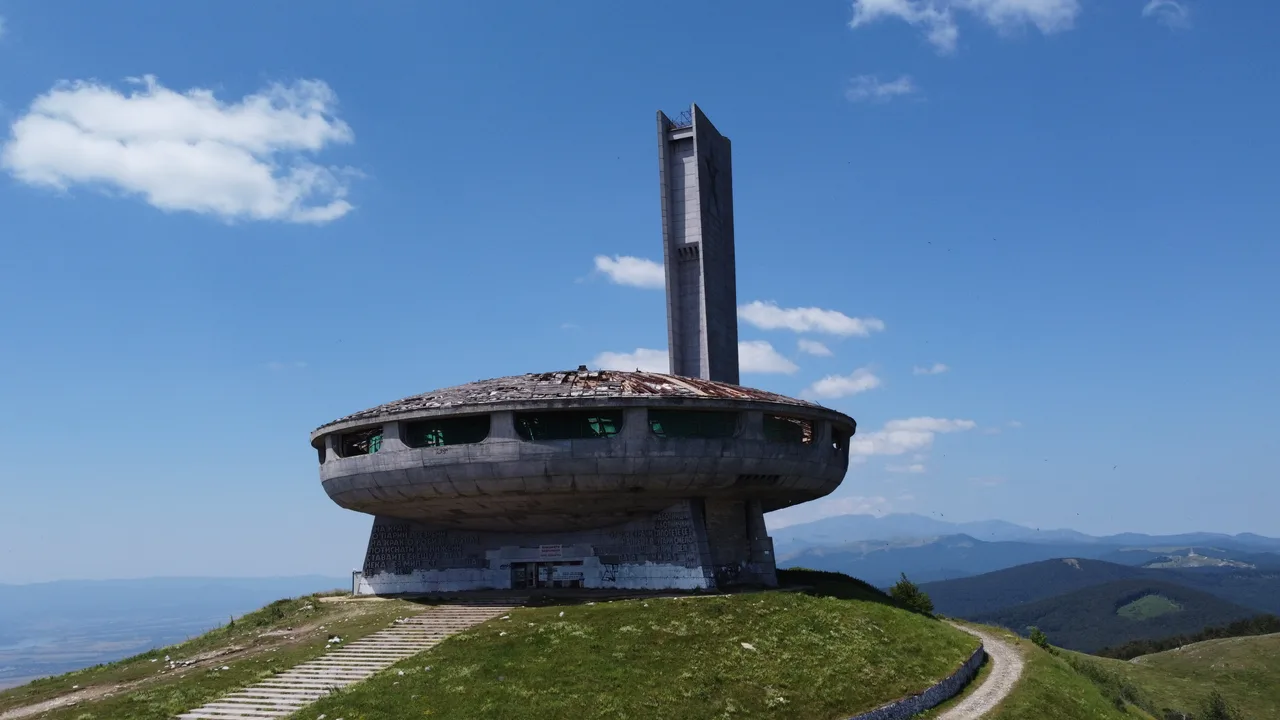
You can visit Buzludzha, but you can’t go inside it. The concrete saucer on the ridge above Kazanlak is sealed, watched by a guard and genuinely unsafe, so every legal visit happens outdoors, on the apron of cracked paving around the building. The upside is that it costs nothing: no ticket office, no barrier, no opening hours. The catch is transport, because nothing on public timetables climbs to the summit at 1,432 metres.
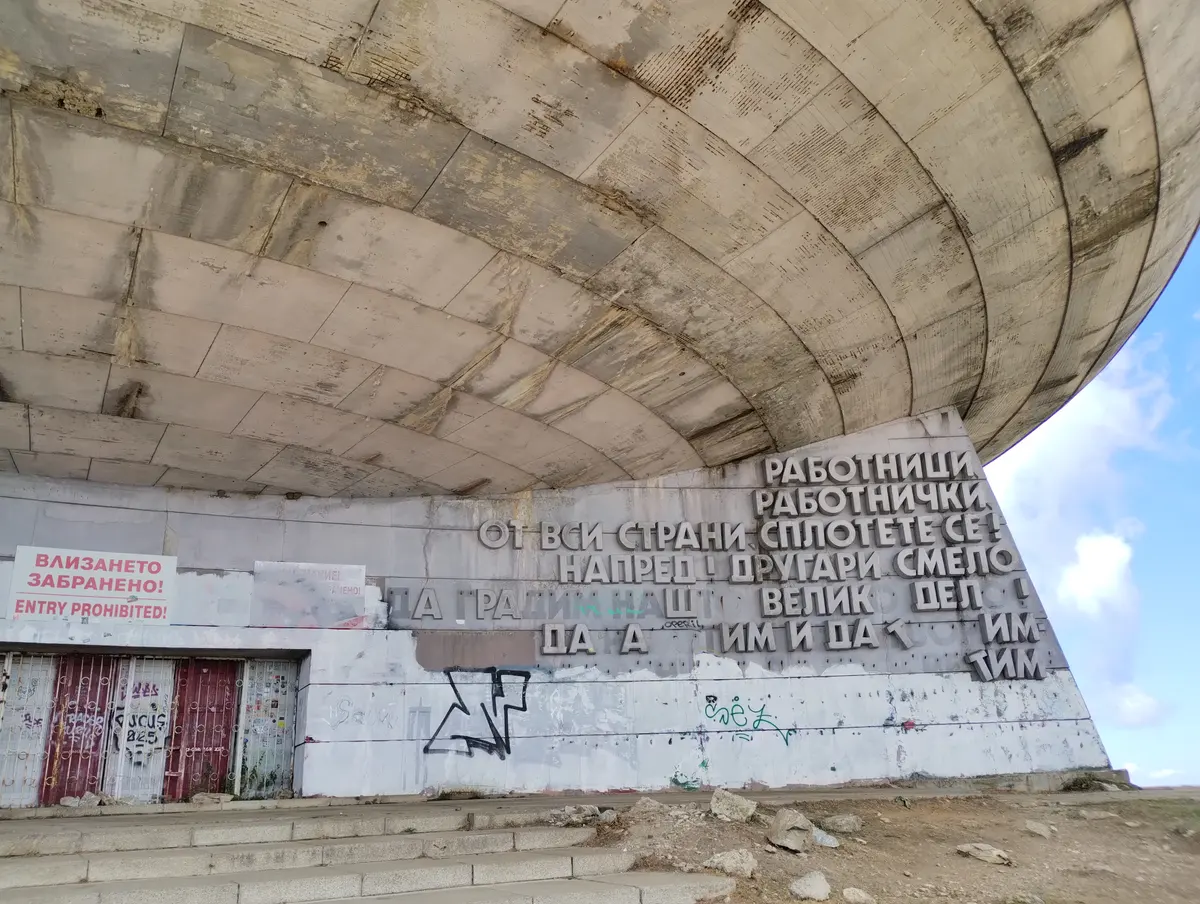
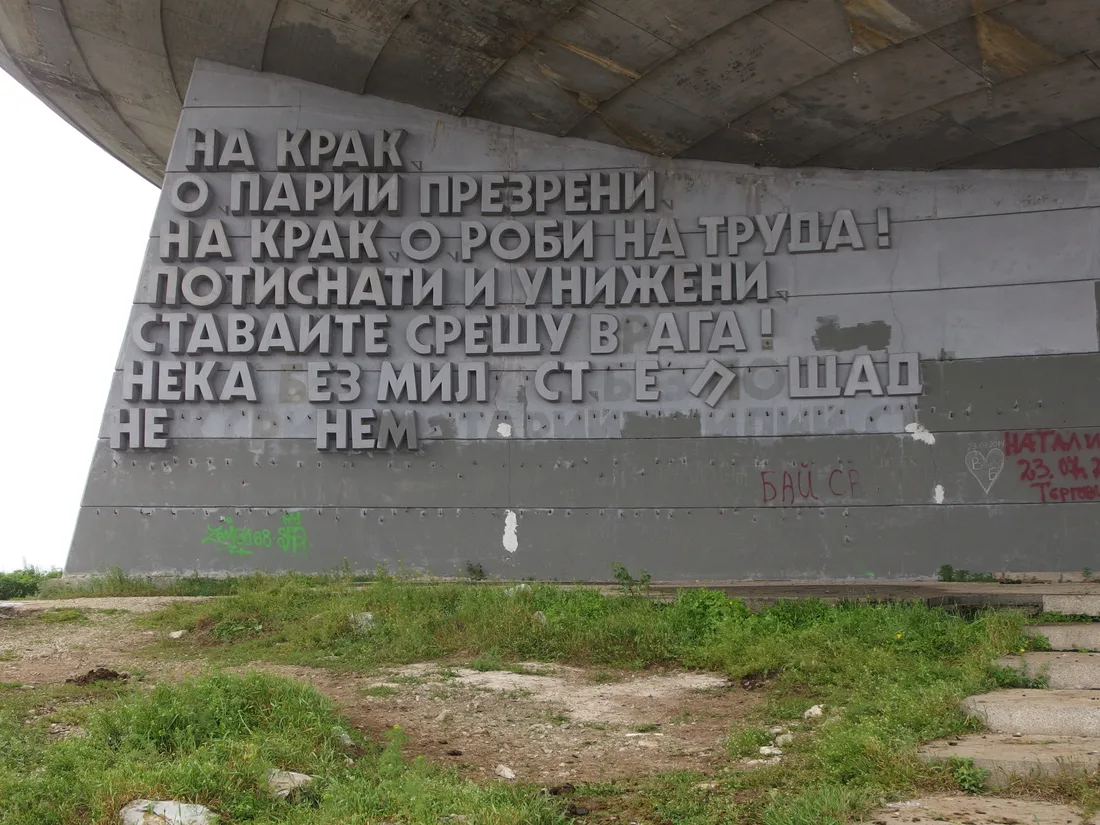
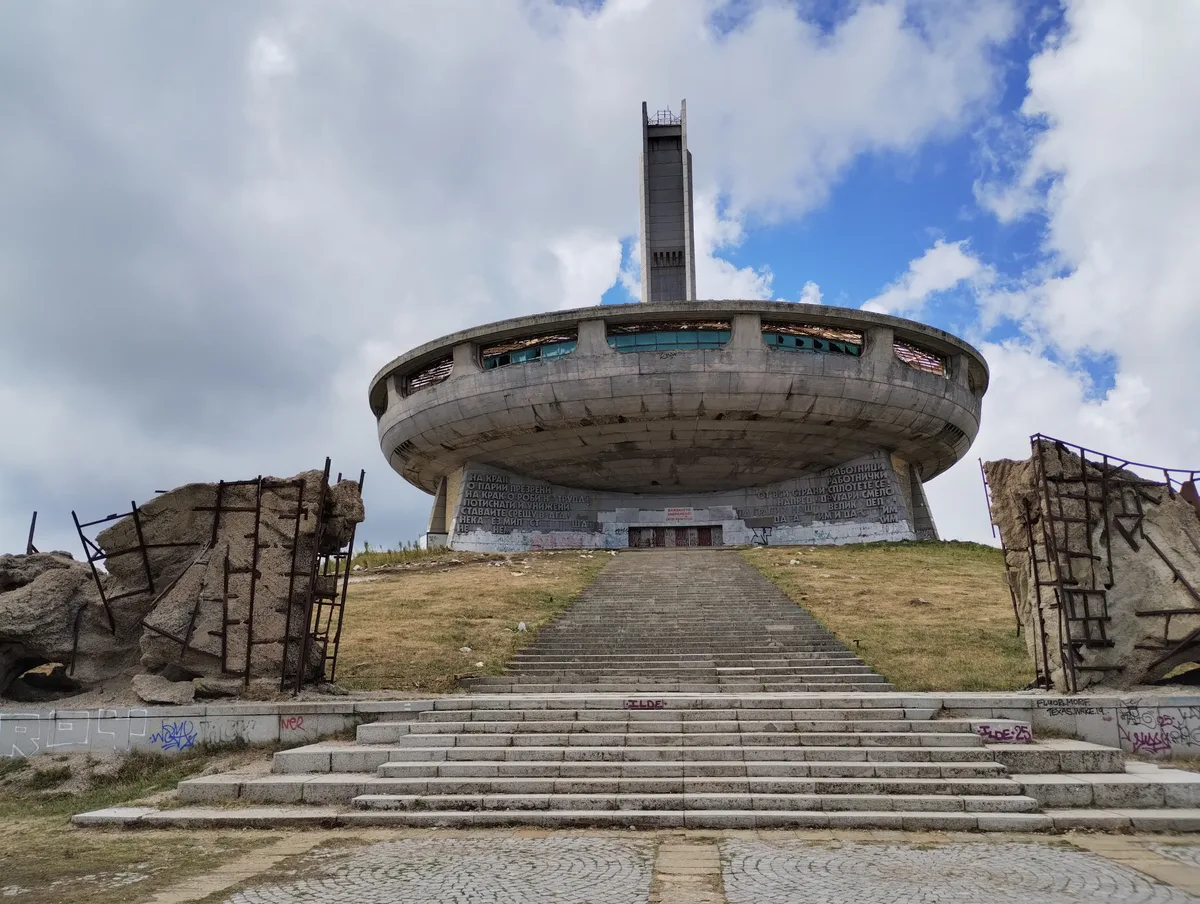
Plenty of people still drive up and leave happy, and the reason is scale. Photographs flatten Buzludzha into a graphic; standing under it, you get a 70-metre pylon, a saucer you can walk right around, and lines from the Internationale spelled out in concrete letters along the outer wall, or what’s left of them. The thing that actually ruins visits isn’t the sealed door but the cloud: at this height the ridge can sit inside a grey wall all afternoon while Kazanlak, half an hour below, is in full sun.
Outside yes, inside no
Take this part seriously. All maintenance stopped when communism fell in 1989, and the building has been closed to the public ever since because the structure is weak. Since 2018 there has been a security hut beside the monument with a guard on duty round the clock, every previous hole has been welded shut with steel plate or packed with stone, and police run checks on people trying to get in. Anyone caught inside risks a fine.
The urban-exploration blog posts and drone-lit YouTube tours you’ve seen were mostly shot before that, in the years when anyone with a torch could crawl in through a gap. That window is closed. The Buzludzha Project Foundation, which is doing the actual conservation work, describes safe public access as its goal, phrasing it as the day visitors “can once again be allowed inside (which is now strictly forbidden)”. No reopening date has been announced.
What it is, and why it sits on this mountain
Buzludzha is a memorial house, and the mountain was chosen long before the concrete arrived. In 1891 a gathering on this peak, led by Dimitar Blagoev, founded the Bulgarian Social Democratic Party, the ancestor of the Bulgarian Communist Party. That’s the anniversary the building commemorates, which is why it stands out here in the wind rather than in a city square.
Construction began on 23 January 1974 and finished in 1981, to a design by architect Georgi Stoilov, and it opened on 23 August 1981. The engineering was as blunt as the politics: the summit was shaved from 1,441 metres down to 1,432 to make a platform, and more than 15,000 cubic metres of rock were carted off the top. The bill came to 14,186,000 leva, worth roughly 35 million US dollars in 2020 money. Inside, some 937 square metres of mosaic were laid using 35 tonnes of cobalt glass.
What is inside, and why you will only see it in photographs
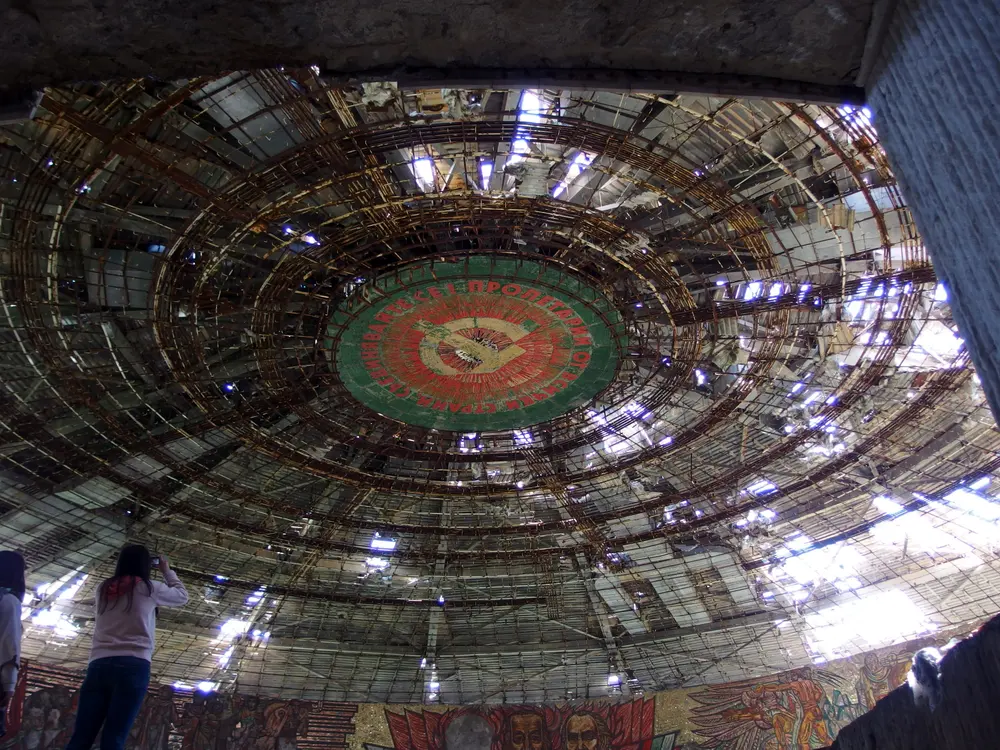
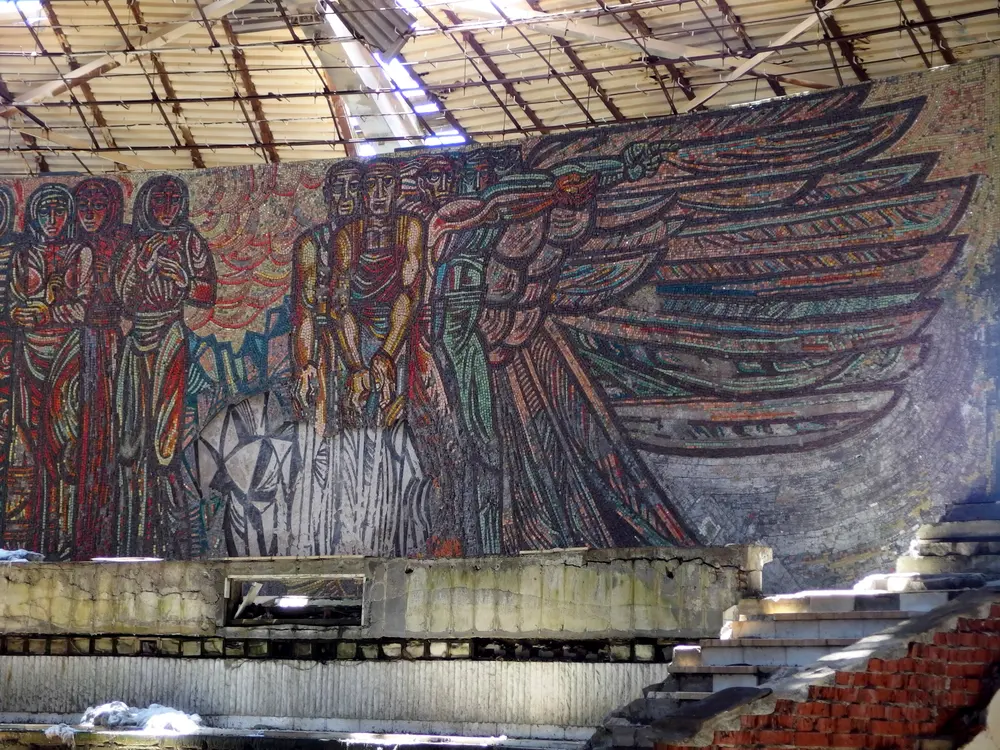
The interior is a single circular hall ringed by mosaic panels, with a ceiling mosaic carrying the slogan “Proletarians of all countries, unite!” at its centre. The panels run through the standard cast of Marx, Engels and Lenin alongside Bulgarian party figures, done in that hard, angular late-socialist style, and they’re the reason people care about this building at all rather than treating it as a lump of ruined concrete.
Roughly a fifth of that mosaic is already gone, lost to weather, age and vandalism. Water was the main culprit: with the roof failing, meltwater ran straight down onto the tesserae, and looters stripped what could be carried. Every interior photograph in this article was taken back in 2014, when the building could still be entered. Treat those images as a record of what the conservation project is trying to save, not as an itinerary.
Who is saving it, and what has actually been done
The Buzludzha Project Foundation was set up in 2015 by the Bulgarian architect Dora Ivanova, and the campaign has since collected the kind of backing that abandoned concrete rarely gets. Europa Nostra listed Buzludzha among Europe’s seven most endangered heritage sites in 2018. The Getty Foundation put up 185,000 US dollars in 2019 for a Conservation Management Plan, drawn up with ICOMOS Germany and the conservation department at the Technical University of Munich, then funded a second project in 2020 to stabilise the mosaics.
The work on the ground has been emergency triage rather than restoration. Between 2019 and 2022 dangerous roof debris was cleared and a temporary shelter was put over the dome mosaic, which stopped the water getting in and probably saved the central artwork. The Conservation Management Plan was completed in 2022. The next step, and the one that decides whether any of this holds, is money for a proper new roof and windows; without them, no serious work can start inside. Beyond that sits the “Open Buzludzha” idea, which is to reuse the shell as a cultural and educational venue while leaving its raw ruined character intact, plus a first permanent exhibition.
That’s the honest state of play: real money, real progress, and no promise about when a visitor might walk in.
Open Buzludzha: the one weekend with a programme
Once a year the site stops being an empty summit. The OPEN BUZLUDZHA festival runs 14 to 16 August 2026, after a fifth edition in August 2025 that doubled as the foundation’s tenth anniversary. The programme is concerts and DJ sets through the night, a 3D projection mapped onto the building’s facade after dark, workshops, historical tours and mountain walks, with a camping field next to the site.
Tickets are sold by the foundation at 45 euro for one day and 55 euro for all three, with camping at 15 euro on top and a 100 euro supporter pass; the regular sale is advertised as running until 31 July. A couple of practical warnings. First, this is the one weekend when the mountain is crowded and beds in Kazanlak and Shipka are scarce, so book early or plan to camp. Second, the published programme is built around the outside of the building, and nothing on the official page promises that ticket holders get into the interior, so don’t buy on that assumption.
Getting up there
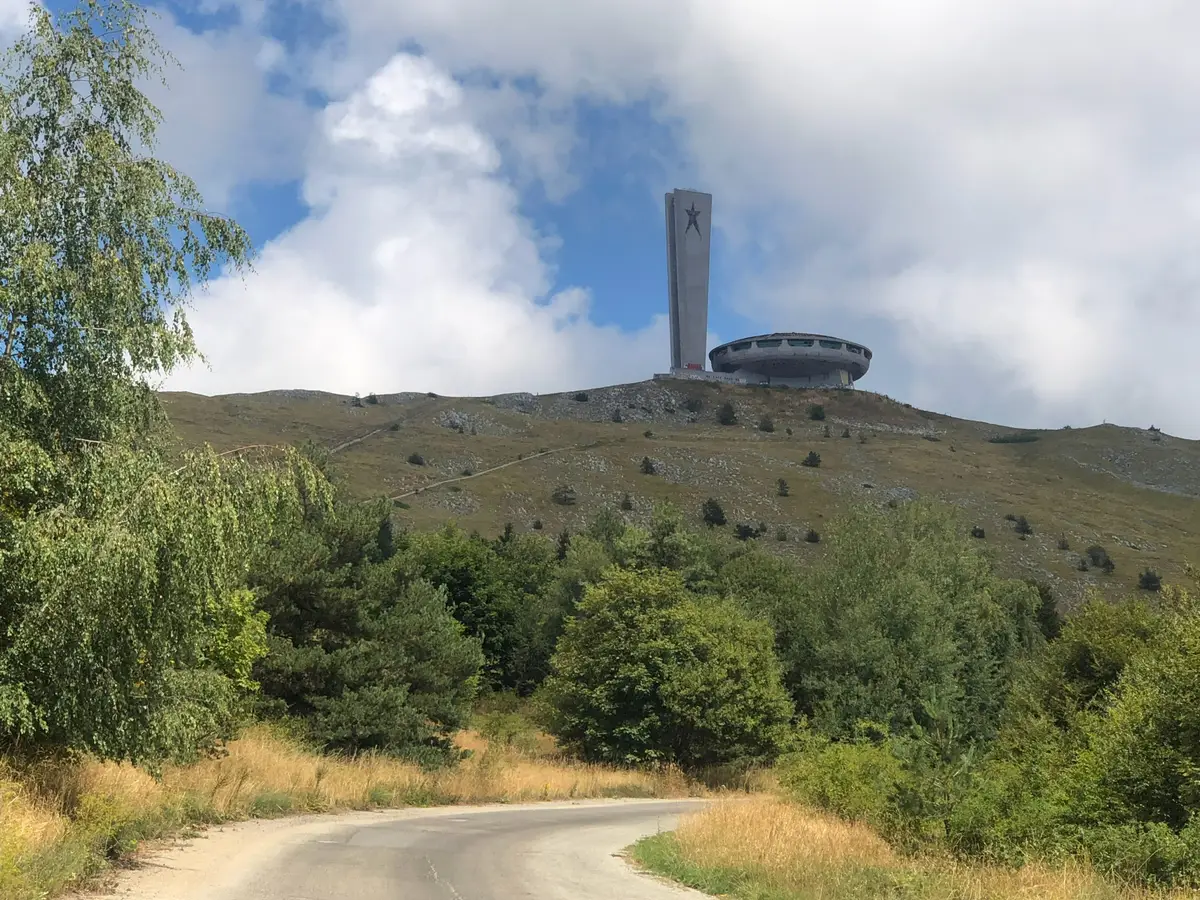
Two side roads climb from the Shipka Pass road: a 16 km approach from the Kazanlak side to the south, and a 12 km approach from Gabrovo to the north. Take the southern one. As of the last published check in October 2023 the Kazanlak road was in noticeably better condition than the northern route, and the difference matters in a small hire car. Kazanlak town itself sits about 25 km below the monument and is the sensible base for the trip.
There’s no bus, no shuttle and no taxi rank at the top, so your options are your own car, a taxi arranged to wait for you, or a guided trip. Organised group tours generally run in the 20 to 40 euro range per person and private cars a good deal more, with a Sofia round trip eating most of an 11-hour day; prices move, so check current rates rather than trusting a figure in an article. If you’re driving yourself, our guide to car rental in Bulgaria covers the paperwork, and driving in Bulgaria covers the mountain-road habits worth knowing before you meet a lorry on a hairpin.
Fill the tank before you start the climb: there’s no fuel, no shop and no cafe on the ridge. The apron around the building is scattered with loose concrete, so wear closed shoes with a firm sole rather than sandals, and a windproof layer earns its place even in August, because the summit runs several degrees colder than the valley floor and the wind is rarely off.
When to go, and how long to give it
June to September is the reliable window. Winter turns the trip into a different proposition: the Shipka Pass ices over, the final road is closed under heavy snow, and getting up there wants a four-wheel drive and someone who has driven mountain roads before. Snow-covered Buzludzha is the most photogenic version of the building and the hardest to reach, which is a fair trade only if you’re equipped for it. For the wider seasonal picture, see when to visit Bulgaria.
An hour on site is enough for most people, two if the light is doing something. Go early rather than at midday, both for the low sun on the concrete and because cloud tends to build over the ridge through the afternoon. Check the forecast for the summit, not for Kazanlak, and keep the trip flexible enough to swap days. If you want Buzludzha as one stop on a multi-day Stara Planina loop (Troyan, Etar, Gabrovo, Kazanlak), our Northern Bulgaria & Balkan Range route lays out the days.
What to pair it with
Don’t drive all that way for one building. The Shipka Freedom Monument stands on the same ridge road about 28 km from Kazanlak, a 31.5-metre stone tower opened in 1934 in memory of the Russian soldiers and Bulgarian volunteers who fell holding the pass in 1877, and it’s reached by a staircase of 890 steps that will remind your legs you’re at altitude. Confirm its opening hours locally, since they shift with the season.
Below in the valley, Kazanlak gives you the UNESCO-listed Thracian tomb and the rose distilleries; our guide to the Valley of Roses sets out what’s worth your time and when the harvest actually happens. String the three together and you have a full, strange, genuinely memorable day: a Thracian burial chamber, a war memorial and a communist spaceship, all within 30 km of each other. If you’re still shaping the trip, things to do in Bulgaria shows where this fits among the rest.
Photos
Admission and opening hours
- Admission price
- Free. The site is unfenced, there is no ticket office and nothing to pay for the grounds.
- Opening hours
- The exterior is accessible at any hour, year round, weather permitting. The interior is sealed and closed to the public.
Entering the building is prohibited: the structure is unsafe, a guard is posted on site and police check the perimeter. Winter access depends entirely on snow, and the final road is closed in heavy falls. Confirm road conditions locally before you set off.
Details checked: July 23, 2026
Distance
- Sofia No public transport goes up the mountain. Full-day guided trips from Sofia run around 11 hours there and back; self-drivers usually route via Kazanlak and the Shipka Pass.
- Plovdiv The handiest base is Kazanlak, roughly 25 km below the monument and about two hours from Plovdiv by bus. From Kazanlak up you still need a car, a taxi booked both ways, or a tour.
- Varna No quick route from the coast. Come via Stara Zagora or Kazanlak, or build it into a central-Bulgaria drive.
Read also

What to see · 13 min read
Skiing in Bulgaria vs the Alps: Honest Verdict
Verified · September 13, 2026Bansko's last published 6-day pass was 341 EUR; Livigno's 2026-27 rate is 374.50 EUR. Real lift-pass, terrain and rental numbers, checked Sep 2026.

What to see · 12 min read
Pirin National Park: Vihren, Trails & Lakes
Verified · September 3, 2026Pirin National Park: the Vihren hut road closure, UNESCO peaks, 27 marked trails, glacial lakes and Bansko visitor centre hours.

What to see · 12 min read
Climbing Musala: The Balkans' Highest Peak
Verified · August 29, 2026Climbing Musala, the Balkans' highest peak at 2,925 m: the Yastrebets gondola schedule and price, the real hiking time from the top station, huts and gear.

What to see · 9 min read
Learning to Ski in Bansko: Schools & Lessons
Verified · August 25, 2026Bansko ski lessons: group and private prices in euros from official schools, Banderishka Polyana base, plus the lift pass you still need. Checked 2026.