
Veliko Tarnovo: Tsarevets Fortress & Old Town
Veliko Tarnovo in a day or two: Tsarevets fortress, the Samovodska Charshia craft street, the Asenevtsi monument, and how to get there from Sofia.
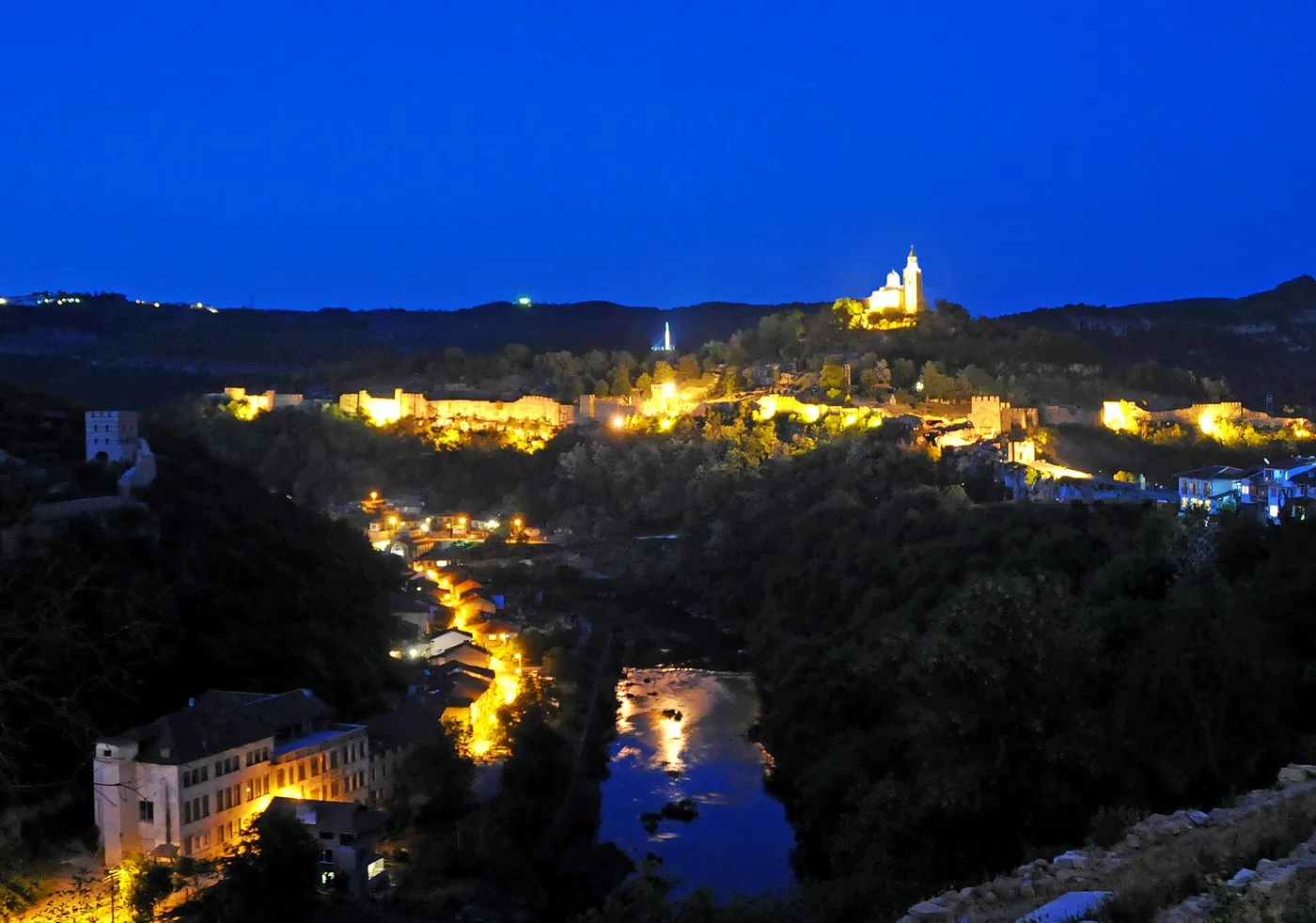
Veliko Tarnovo is Bulgaria’s medieval capital, a town of ochre houses stacked up a bend in the Yantra river gorge, crowned by the great hilltop fortress of Tsarevets. Give it a full day for the fortress and the old craft street, or better a night as well so you catch the walls lit up. One day covers the headline sights on foot; two lets you slow down over the Revival-era lanes and the viewpoints. Prices below are in euros, because Bulgaria joined the eurozone on 1 January 2026, though small kiosks here still prefer cash.
Two things are worth planning around: the fortress keeps shifting its summer hours, and the sound-and-light show over Tsarevets only runs on certain nights - catch it and the walls light up over the gorge, miss it and you’ll wish you had checked. If Veliko Tarnovo is one leg of a longer trip, it slots neatly onto the 7-day Bulgaria itinerary as the final stop, and it pairs well with a couple of days in Sofia first.
How long do you need in Veliko Tarnovo?
One full day is enough to see Tsarevets and wander the old town without sprinting. Add a second day if you want to breathe: linger on the craft street, hunt down the balcony viewpoints, and take a half-day out to a nearby village or the rock churches. The town is small, and almost everything sits within a 20-minute walk of Stefan Stambolov street, the spine of the old quarter.
The one thing worth timing is the Sound and Light show over Tsarevets (more on that below): it doesn’t run every night, so if seeing it matters to you, check the dates before you fix your nights here. Otherwise, come whenever suits; late spring and September give you warm evenings without the peak-summer heat that bakes the exposed fortress hill.
Tsarevets Fortress: the heart of it
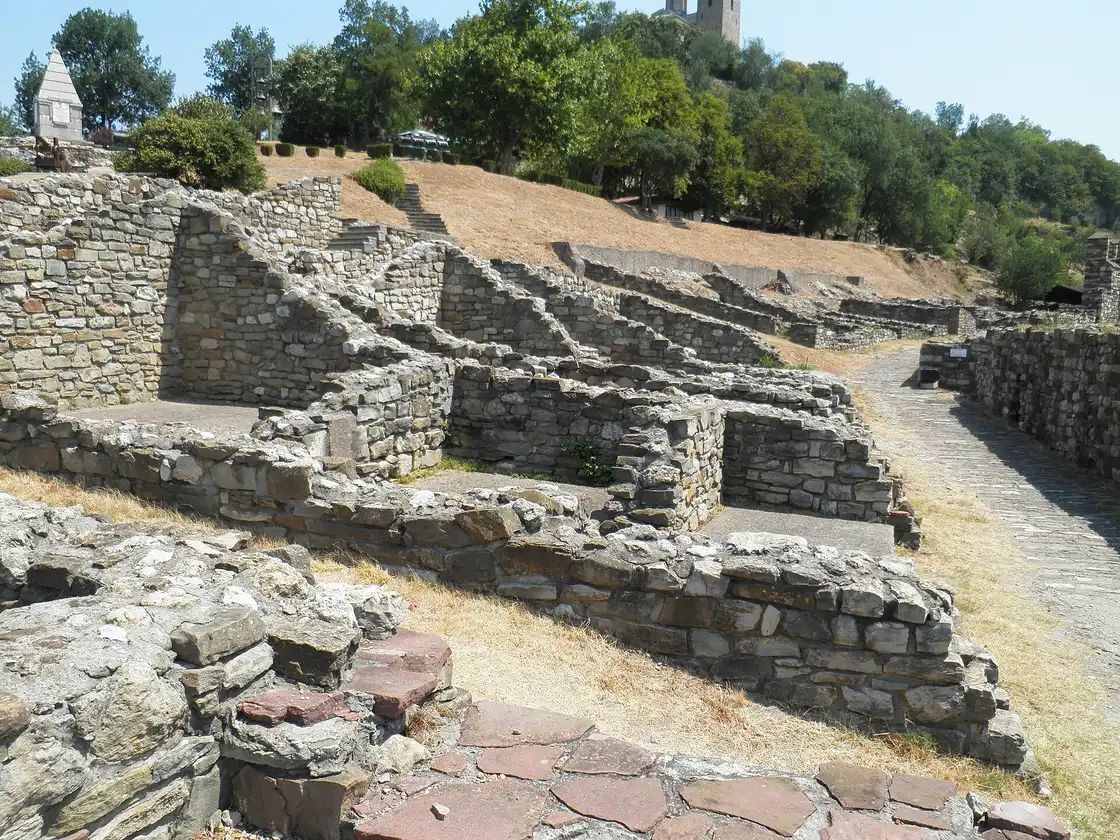
Start here, because Tsarevets is the reason the town exists in the form it does. This was the primary fortress and stronghold of the Second Bulgarian Empire from 1185 to 1393, the seat of kings and patriarchs, a walled city on its own hill above the river. At its height archaeologists have counted the remains of around 400 dwellings, more than 22 churches, and four monasteries inside the walls, which ran up to 3.6 metres thick with three gates guarding the approaches.
It all ended on 17 July 1393, when Ottoman forces took the hill after a three-month siege and burnt it down, closing the book on the medieval Bulgarian state. What you walk today is a mix of original stone and careful reconstruction: cobbled paths climb between the excavated foundations, and the whole circuit gives you the shape of a lost capital rather than a polished museum. Wear proper shoes; the paths are uneven and there’s very little shade.
What to look for inside
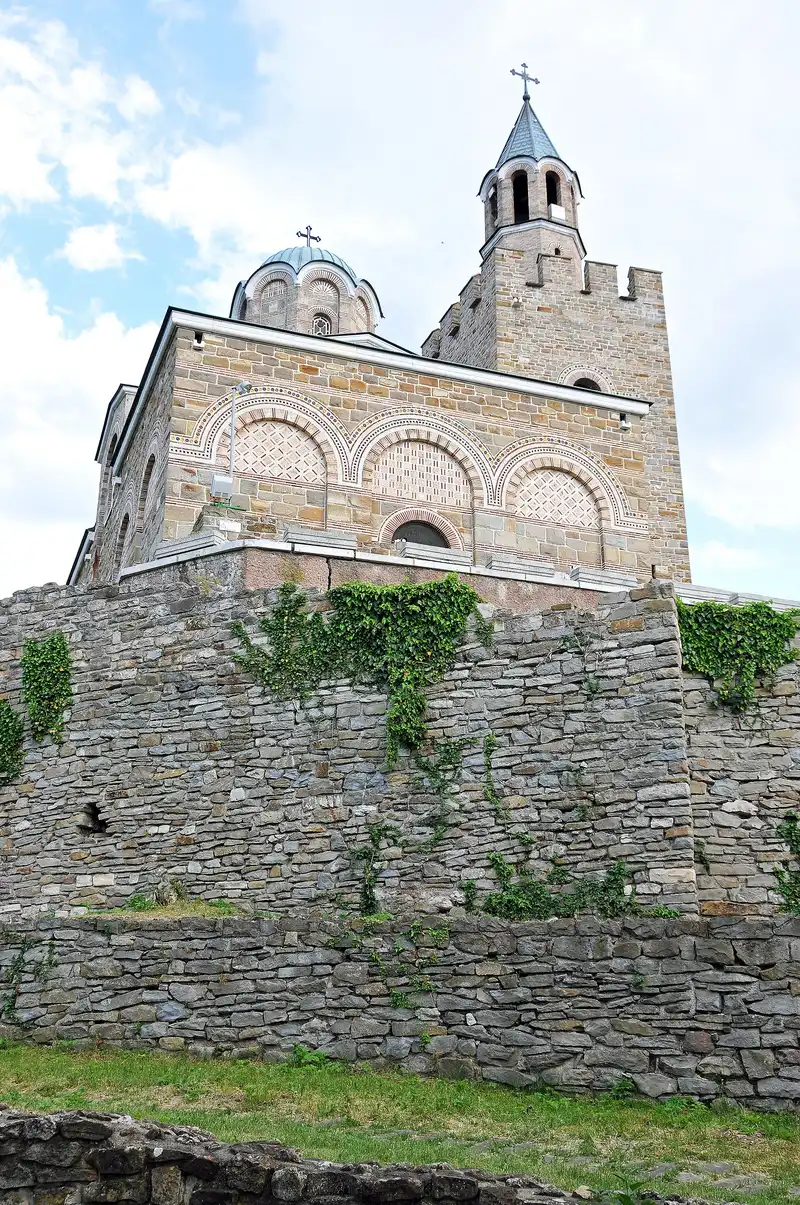
Three things anchor the visit. At the very top stands the Patriarchal Cathedral of the Holy Ascension, the spiritual centre of the medieval empire, rebuilt in 1981 and painted in 1985. Step inside and it surprises you: instead of the usual gold-ground icons, the walls carry stark, modernist murals that tell the story of medieval Bulgaria in a near-expressionist style. You either love it or find it cold, but nobody forgets it.
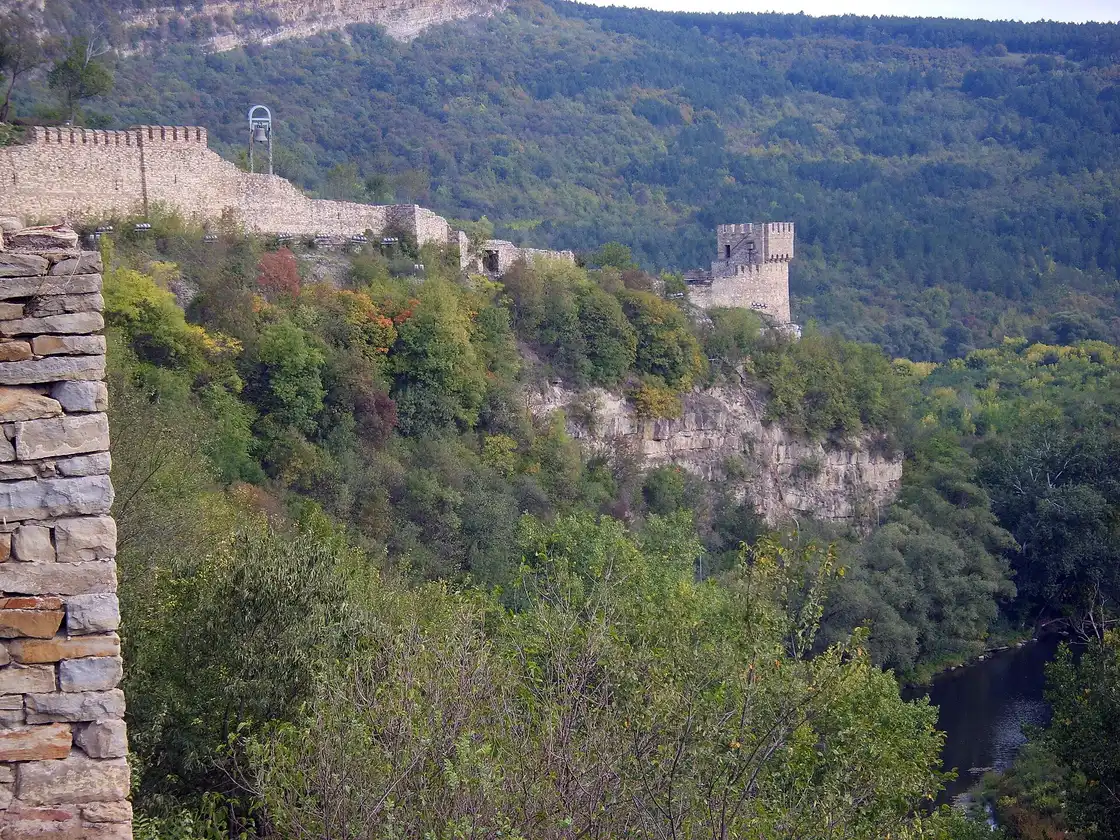
Down at the southeastern corner is Baldwin’s Tower, rebuilt on the spot linked by legend to Baldwin I of Flanders, the first Latin emperor of Constantinople, captured by Tsar Kaloyan after the battle of Adrianople in 1205 and, the story goes, held and killed here. You can climb it for a view down the gorge. And at the northern tip, a rocky spur over the river is the Execution Rock, from which traitors to the state were thrown into the Yantra from the 11th to the 14th century.
Tsarevets hours and tickets
The official operator is the Regional Museum of History. The adult ticket is 7.67 euros (about 15 leva), with a family ticket (two adults plus up to three children aged 7 to 18) at 10.23 euros; a guided tour in Bulgarian is roughly 15 euros on top, more with a translator. Buy at the gate.
Hours are the fiddly bit. The museum publishes a winter schedule of 08:00 to 20:00 (last entry 16:00) for November to March; in summer the reserve stays open longer into the evening, but the exact closing time isn’t posted clearly, so confirm on the day rather than trusting a fixed number online. Budget one and a half to two hours to do the hill justice. There’s a small cafe by the entrance, but bring water for the walk itself.
The Sound and Light show
On certain evenings the whole fortress becomes the stage for “Sound and Light” (Zvuk i Svetlina), a son-et-lumiere of coloured floodlights, lasers, and music narrating the fall of Tarnovo in 1393. It’s genuinely dramatic, and here’s the money-saving part: you can watch it free from Tsar Asen I Square directly in front of the hill. Paid tickets only buy you a spot on a dedicated panoramic platform.
The catch is that there’s no fixed nightly schedule. The show runs on national holidays, big local events, and by advance booking for tour groups, so on a random Tuesday it may simply not happen. If catching it matters, check the official site (soundandlight.bg) or ask at the tourist information centre when you arrive, and plan your evening around a confirmed date.
Samovodska Charshia: the old craft bazaar
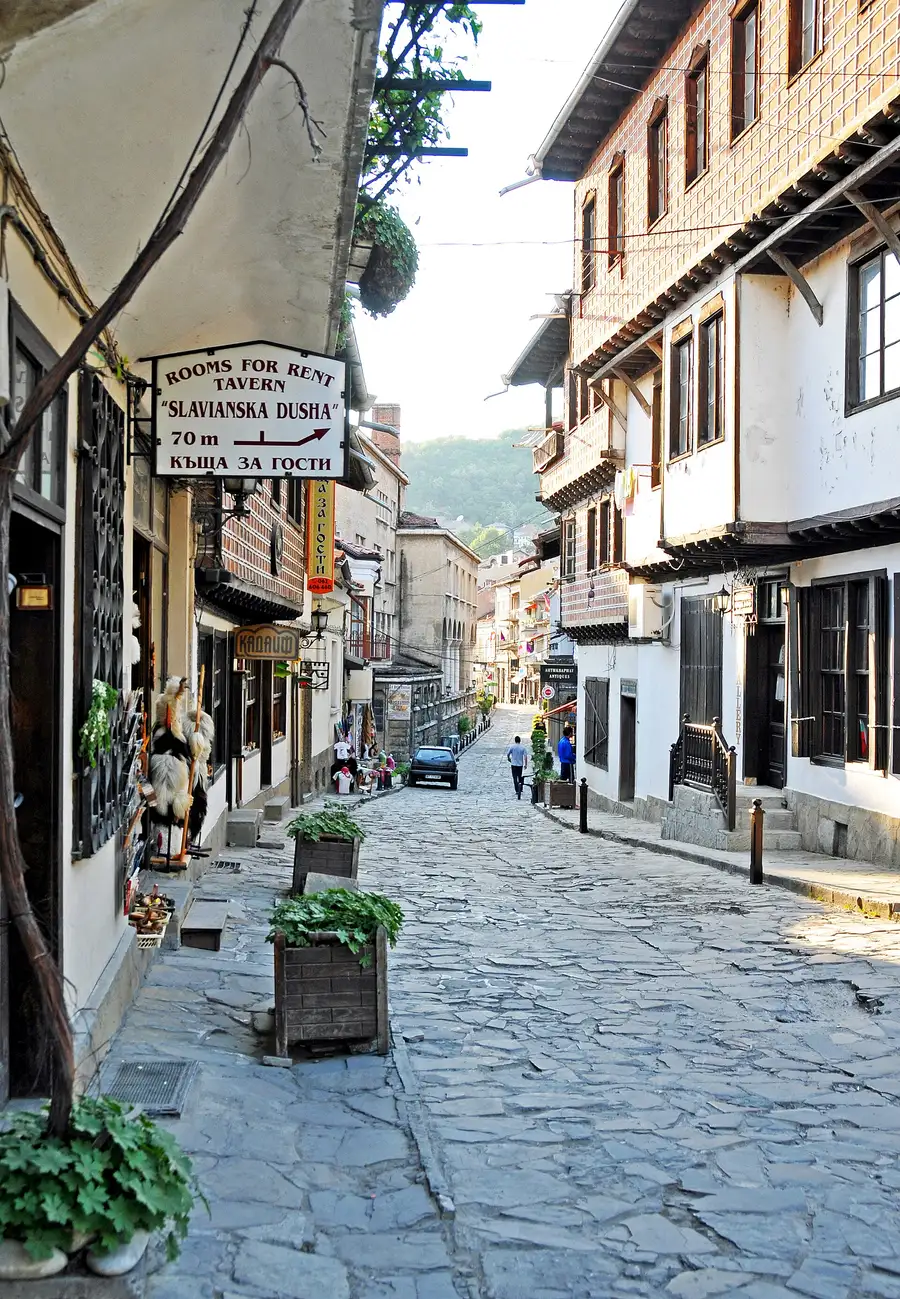
A few minutes’ walk from the fortress, the Samovodska Charshia is the restored 19th-century market quarter, and it’s the most atmospheric corner of the old town. It grew in the second half of the 1800s as the spot where villagers from nearby Samovodene brought their produce, and where blacksmiths, potters, coppersmiths, and confectioners set up shop. A major restoration in the mid-1980s brought the cobbled lanes and craft houses back to their turn-of-the-century look.
What makes it more than a souvenir strip is that the crafts are still worked. Along the lane you can watch a potter, a coppersmith, a wood-carver, a weaver, and an icon painter at their benches, plus a bakery and a maker of Turkish sweets, all working in view of passers-by. Look out for the Hadzhi Nikoli Inn of 1858, a beautifully preserved merchants’ inn that now houses a restaurant and gallery. Come in the morning if you want the workshops open and the lane quiet.
The Asenevtsi Monument and the Yantra views
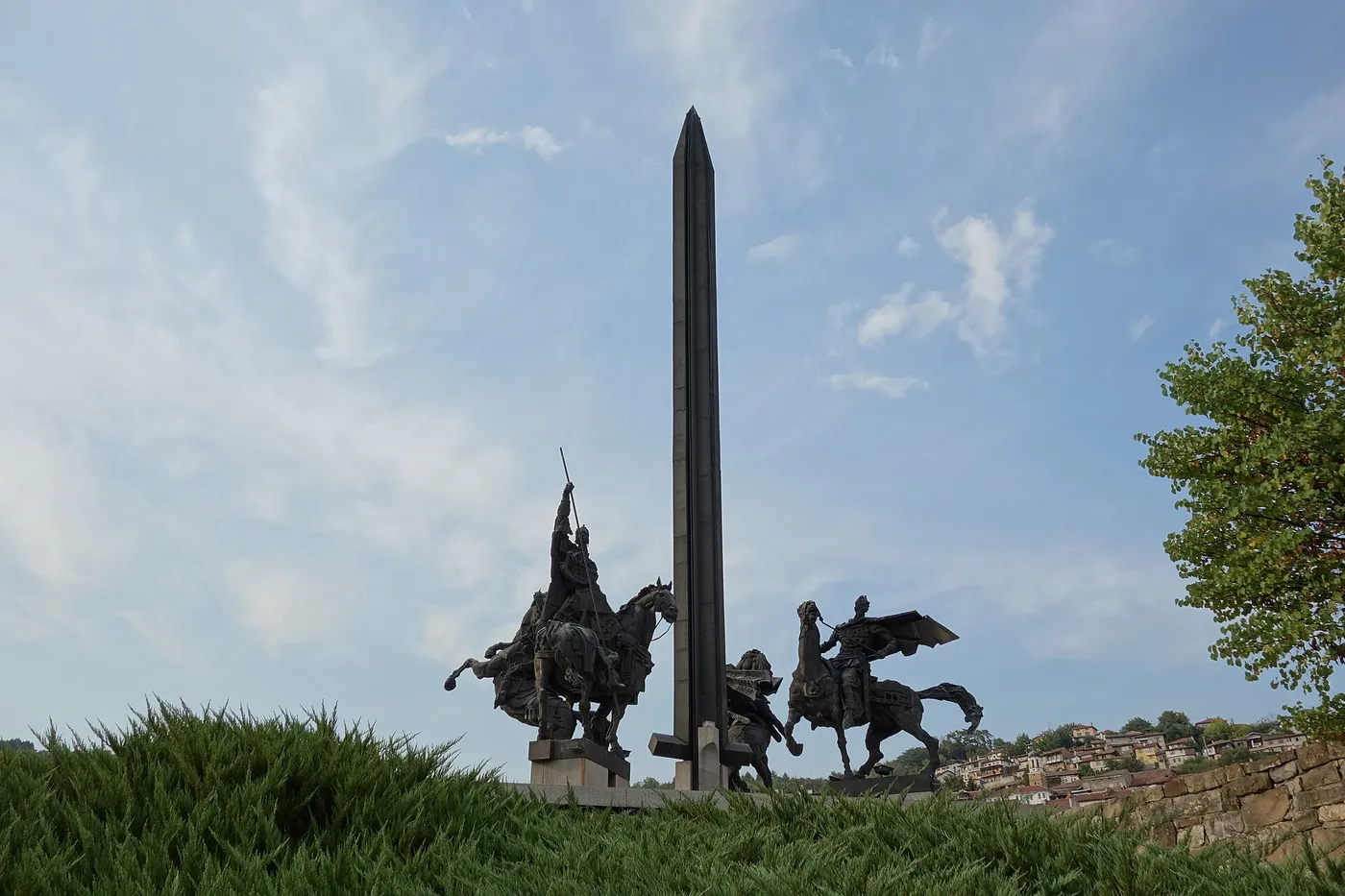
Down where the Yantra loops around a spur of land, the Asenevtsi Monument is the town’s boldest piece of public sculpture. Unveiled in 1985 for the 800th anniversary of the Asen brothers’ uprising, it sets four mounted tsars (Asen, Peter, Kaloyan, and Ivan Asen II, who led the Second Bulgarian Empire to its peak) around a huge vertical sword pointing at the sky. It’s theatrical and a little Soviet in scale, and the setting on the river bend makes it one of the best photo spots in town.
The walk out to it doubles as a viewpoint tour. Veliko Tarnovo is really a town of viewpoints: houses cling to the gorge in tiers, and every few streets a balcony or terrace opens onto the river and the fortress opposite. Stefan Stambolov street and Gurko street are the classic ones, the latter a steep cobbled lane of Revival houses that’s probably the most photographed street in Bulgaria.
How to get to Veliko Tarnovo from Sofia
The town sits about 230 km northeast of the capital, and the honest answer is: take the bus or drive, skip the train. Our Sofia to Veliko Tarnovo guide covers that route in detail, and Plovdiv to Veliko Tarnovo does the same from the south.
By bus is the easy default. Around 23 services a day run from Sofia’s central bus station, with the fastest scheduled at roughly 2 hours 24 minutes (Traventuria) and most taking 3 to 3.5 hours; fares are about 12 to 20 euros. Operators include Grup Plus, Union Ivkoni, Infobus, and Traventuria, so departures are frequent enough that you rarely wait long.
By car takes about 2 hours 40 minutes: east out of Sofia onto the A2 “Hemus” motorway, then off near Veliko Tarnovo onto the E85. A car is worth it if you want to add the rock-hewn churches of Ivanovo or the village of Arbanasi on the same trip.
By train is the one to avoid unless you love railways: there’s no direct line, so you change at Gorna Oryahovitsa (the junction about 10 km from town), and the whole thing takes 4 to 5 hours for the sake of saving a euro or two. If you’re flying into Sofia and want the door-to-door option with luggage, a private transfer removes the bus-station shuffle.
Where to stay and what comes next
Base yourself in the old town, along or just off Stefan Stambolov street, and you’ll have the fortress, the craft bazaar, and the best river views within a short walk, many of them from a guesthouse balcony. Rooms here are good value even on the euro, and a night in the old quarter is what turns Veliko Tarnovo from a day trip into a proper stop. For the specific areas and the best gorge-view guesthouses, our guide to where to stay in Veliko Tarnovo weighs up each one.
From here the natural moves are onward: back toward Sofia and the west, or looping the country on the 7-day Bulgaria itinerary, which threads Veliko Tarnovo together with the capital, Plovdiv, and Rila Monastery. It’s also the classic first stop if you’re crossing into Romania: our Sofia to Bucharest guide shows how to break that trip here and carry on via Ruse and the Danube bridge. If you have a car and half a day to spare, the frescoed village of Arbanasi is barely ten minutes up the hill and makes an easy add-on. And if Tsarevets leaves you hungry for more castles, the country’s most dramatic is the Belogradchik fortress in the far northwest, built straight into a field of red rock towers.
Photos
Read also

Cities · 10 min read
Bulgaria's Spa Towns: Velingrad, Hisarya & More
Verified · August 31, 2026Compare Velingrad, Sandanski and Hisarya: water temps, climate, Roman walls, when to go year-round, and real 2026 spa-hotel rates.

Cities · 12 min read
Where to Stay in Pamporovo: Hotels & Chalets
Verified · August 22, 2026Pamporovo hotels, chalets and apartments by lift base: Malina vs Studenets, why "renovated" is not "new", and how to price a bed.

Cities · 14 min read
2 Days in Sofia: The Perfect Weekend Itinerary
Verified · August 20, 2026A 2-day Sofia itinerary for a Friday-to-Sunday trip: Nevsky, Serdica, Boyana Church, real euro prices, and what actually fits in one weekend.

Cities · 9 min read
Where to Stay in Burgas: Best Areas & Hotels
Verified · August 10, 2026Where to stay in Burgas: city centre for a first visit, Sea Garden for beach and park, Lazur for quiet value, or Sarafovo by the airport.